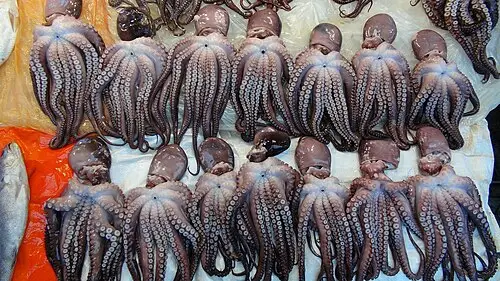
 📸 Photo
Photo: Ulrich Walder · CC0 · Wikimedia Commons Source
Long-armed octopus
Octopus minor (Long-armed octopus · テナガダコ)
💡 Everyday Comparisons for Size, Mass & Speed
- 💡 It is still popularly eaten today as stir-fried octopus and live sliced octopus, and is also used as a filling ingredient in winter kimchi making (Encyclopedia of Korean Culture).
- 💡 The Korean proverb 'Spring clams, autumn long-armed octopus' is used to mean that things are at their best in their proper season (Encyclopedia of Korean Culture).
- 💡 Its maximum length of 70 cm is slightly shorter than the length of a baseball bat (about 85 cm) (Comparison).
Reference standards: coach bus ~12 m, mid-size car ~4.9 m, compact car ~1 t, basketball hoop 3.05 m, credit card 8.56 cm.
📖 1. Overview
The long-armed octopus lives in shallow coastal waters of Korea, China, and Japan, and in Korea it is caught in especially large numbers along the coasts of Jeollanam-do and Jeollabuk-do.
🦴 2. Anatomy & Morphology
Its body consists of three parts—a round sac-like mantle, a head, and arms—and its 8 arms are very long relative to its body size. The arms bear 1–2 rows of suckers, and the mouth at the center of the arms contains sharp beaks.
🔍 3. Ecology & Behavior
It lives hidden in rock crevices or mud in shallow seas and feeds on crustaceans. It is usually pale gray to dark gray, turning deep red when in danger or stimulated.
🇰🇷 4. Connection to Korea
Recorded in the historical treatise Jasaneobo as tasty and good for raw dishes, soup, and dried strips, it is still enjoyed today as stir-fried octopus (nakji-bokkeum) and live sliced octopus (sannakji-hoe). It is listed as Nakji (Korean name) on the National List of Species of Korea.
📚 Sources & References
- • IUCN Red List DD (2018) — https://www.iucnredlist.org/species/83457578/83457612
- • IUCN Red List category DD — latest assessment at iucnredlist.org
- • marinespecies.org — aphia.php
- • iucnredlist.org — 83457612
- • 국가생물종목록(국립생물자원관) ktsn 120000044098 — https://species.nibr.go.kr/home/mainHome.do?cont_link=009&subMenu=009002&contCd=009002&ktsn=120000044098
- • wikidata.org — Q76565
- • sealifebase.se — Octopus-minor.html
- • encykorea.aks.ac.kr — E0011656
- • Silhouette: PhyloPic — Margot Michaud · CC0 1.0 (Congeneric silhouette — Octopus)
Recorded dimensions are widely cited representative estimates from public literature and may vary by study or specimen.