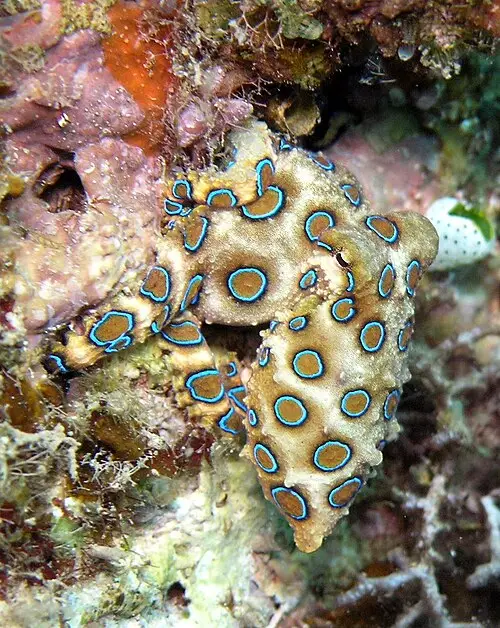
 📸 Photo
Photo: Jens Petersen · CC BY 2.5 · Wikimedia Commons Source
Greater blue-ringed octopus
Hapalochlaena lunulata (Greater blue-ringed octopus · Greater blue-ringed octopus)
💡 Everyday Comparisons for Size, Mass & Speed
- 💡 Its maximum total length of 12 cm is just slightly longer than the long side of a credit card (about 8.6 cm).
- 💡 Its maximum weight of 100 g is around the weight of 2 chicken eggs.
- 💡 Its venom component (tetrodotoxin) is studied in medical and psychological research because it blocks sodium channels in nerve cells, and 1 individual was once sold for 4,000 dollars at an auction in Sydney, Australia (ADW).
Reference standards: coach bus ~12 m, mid-size car ~4.9 m, compact car ~1 t, basketball hoop 3.05 m, credit card 8.56 cm.
Site-computed relative index from recorded values; not a formal scientific metric.
📖 1. Overview
The greater blue-ringed octopus is a tiny octopus living in shallow coral reefs and rock pools of the Indo-West Pacific. The blue ring patterns on its body are a warning of its potent venom.
🦴 2. Anatomy & Morphology
It is very small, with a total length of 12 cm and a mantle length of about 5 cm. Its color pattern warns of potent venom, likely tetrodotoxin, and direct handling should be avoided.
🔍 3. Ecology & Behavior
Except when mating, it lives alone and spends most of its time hiding in rock crevices, ambushing small marine animals such as fish, crabs, and clams. It injects venomous saliva into its prey to kill it. The female carries 60–100 eggs beneath her arms and guards them for about 50 days.
🇰🇷 4. Connection to Korea
No direct record connecting this species to Korea has been found.
📚 Sources & References
- • IUCN Red List LC (2018) — https://www.iucnredlist.org/species/163293/994503
- • IUCN Red List category LC — latest assessment at iucnredlist.org
- • marinespecies.org — aphia.php
- • iucnredlist.org — 994503
- • wikidata.org — Q1123809
- • commons.wikimedia.org — File:Hapalochlaena lunulata2.JPG
- • sealifebase.se — Hapalochlaena-lunulata.html
- • animaldiversity.org — Hapalochlaena lunulata
- • Silhouette: PhyloPic — Kurtis Wothe · CC0 1.0 (Related taxon silhouette — Octopodidae)
Recorded dimensions are widely cited representative estimates from public literature and may vary by study or specimen.