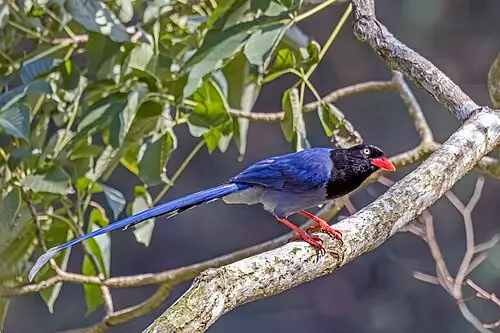
 📸 Photo
Photo: Charles J. Sharp · CC BY-SA 4.0 · Wikimedia Commons Source
Taiwan Blue Magpie
Urocissa caerulea (Taiwan Blue Magpie · ヤマムスメ)
💡 Everyday Comparisons for Size, Mass & Speed
- 💡 Its tail alone is about 40 cm long, well over half of its total length of 65 cm (40 ÷ 65 ≈ 62%, Comparison).
- 💡 Because flocks fly in single file, it is also called the 'long-tailed formation' in Taiwan (Tri-Mountain National Scenic Area Administration).
- 💡 It can be seen in low- to mid-elevation broadleaf forests in Taiwan such as Lion's Head Mountain (Tri-Mountain National Scenic Area Administration).
Reference standards: coach bus ~12 m, mid-size car ~4.9 m, compact car ~1 t, basketball hoop 3.05 m, credit card 8.56 cm.
📖 1. Overview
The Taiwan Blue Magpie is a crow-family bird endemic to Taiwan that flies in single-file flocks trailing its long tail.
🦴 2. Anatomy & Morphology
Its body is mostly blue with a paler belly, a black head, neck, and breast, a red bill and feet, and yellow eyes. Its wingtips are spotted with white, and its very long tail feathers have white tips.
🔍 3. Ecology & Behavior
It is omnivorous, eating seeds, fruits, and insects. During the April–August breeding season, it builds a shallow saucer-shaped nest of twigs, vines, and grass on horizontal treetop branches and lays 4–6 eggs, using a helper system in which individuals other than the parents also help raise the chicks.
🇰🇷 4. Connection to Korea
No direct record connecting this species to Korea has been found.
📚 Sources & References
- • IUCN Red List LC (2018) — https://www.iucnredlist.org/species/22705793/130380699
- • IUCN Red List category LC — latest assessment at iucnredlist.org
- • doi.org — avilist.v2026
- • iucnredlist.org — 130380699
- • wikidata.org — Q94533
- • commons.wikimedia.org — File:Taiwan blue magpie (Urocissa caerulea) Xindian.jpg
- • trimt-nsa.gov.tw — 98
- • Silhouette: PhyloPic — Andy Wilson · CC0 1.0 (Related taxon silhouette — Perisoreus canadensis)
Recorded dimensions are widely cited representative estimates from public literature and may vary by study or specimen.