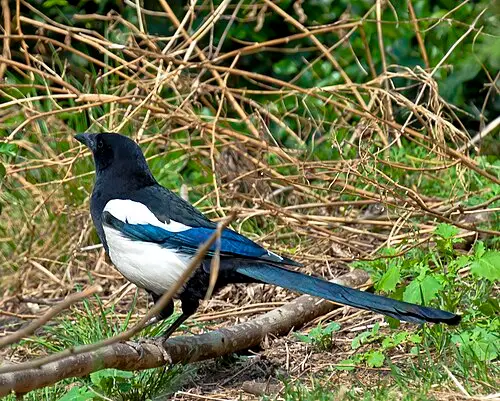
 📸 Photo
Photo: Daniel Case · CC BY-SA 3.0 · Wikimedia Commons Source
Oriental Magpie
Pica serica (Oriental Magpie · カササギ)
Not Evaluated (NE) on the IUCN Red List yet.
💡 Everyday Comparisons for Size, Mass & Speed
- 💡 Known traditionally as a bird that brings good news, it is also considered a nuisance bird in daily life today (Encyclopedia of Korean Culture).
- 💡 Its body length of 50 cm (including the tail) is a little over twice the diameter of a soccer ball (about 22 cm) (Comparison).
Reference standards: coach bus ~12 m, mid-size car ~4.9 m, compact car ~1 t, basketball hoop 3.05 m, credit card 8.56 cm.
Site-computed relative index from recorded values; not a formal scientific metric.
📖 1. Overview
The Oriental Magpie is a black-and-white corvid with a long tail that commonly lives close to human settlements in Korea.
🦴 2. Anatomy & Morphology
Its head, breast, and back are black, its shoulders and belly are white, and its long tail is black with a green and purplish gloss.
🔍 3. Ecology & Behavior
It forages on the ground and is an omnivore that eats bird eggs, chicks, cherries, and more indiscriminately. It nests in broadleaf trees near houses, laying 5–6 eggs and incubating them for 17–18 days.
🇰🇷 4. Connection to Korea
It is a resident bird seen nationwide except on Jeju Island and Ulleungdo (the Encyclopedia of Korean Culture lists its scientific name as Pica pica).
📚 Sources & References
- • IUCN Red List: not evaluated (NE) — cross-checked with the Wikidata conservation-status entry
- • doi.org — avilist.v2026
- • 국가생물종목록(국립생물자원관) ktsn 120000532854 — https://species.nibr.go.kr/home/mainHome.do?cont_link=009&subMenu=009002&contCd=009002&ktsn=120000532854
- • wikidata.org — Q1133750
- • commons.wikimedia.org — File:Oriental Magpie on Longevity Hill, Beijing.jpg
- • avifauna.hkbws.org.hk — 033600
- • bto.org — magpie
- • encykorea.aks.ac.kr — E0011213
- • Silhouette: PhyloPic — T. Michael Keesey · CC0 1.0 (Congeneric silhouette — Pica hudsonia)
Recorded dimensions are widely cited representative estimates from public literature and may vary by study or specimen.