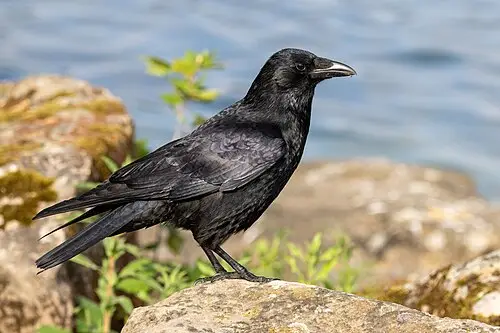
 📸 Photo
Photo: Alexis Lours · CC BY 4.0 · Wikimedia Commons Source
Carrion Crow
Corvus corone (Carrion Crow · ハシボソガラス)
💡 Everyday Comparisons for Size, Mass & Speed
- 💡 Its body length of 47 cm is about one and a half 30 cm rulers (Comparison).
- 💡 In cities, it nests in parks and on buildings and searches for food in landfills and trash bins (ADW).
- 💡 It has been reported using cars to crack open hard nuts (ADW).
Reference standards: coach bus ~12 m, mid-size car ~4.9 m, compact car ~1 t, basketball hoop 3.05 m, credit card 8.56 cm.
Site-computed relative index from recorded values; not a formal scientific metric.
📖 1. Overview
The carrion crow is a medium-sized all-black crow that lives year-round across Korea as a common resident bird.
🦴 2. Anatomy & Morphology
Its body is black overall, showing a green gloss in winter and a slight brownish cast in summer. Its bill and legs are also black, and females are the same color as males but slightly smaller.
🔍 3. Ecology & Behavior
It is omnivorous, eating the eggs and chicks of other birds, small mammals, insects, acorns, grains, and fruits. It lays 3–5 eggs in March–June (months 3–6) and forms flocks in winter after breeding.
🇰🇷 4. Connection to Korea
According to the National List of Species of Korea, it is distributed nationwide and is a common resident bird living in tall trees near rural homes, in mountains, and along beaches.
📚 Sources & References
- • IUCN Red List LC (2024) — https://www.iucnredlist.org/species/22706016/264543876
- • IUCN Red List category LC — latest assessment at iucnredlist.org
- • doi.org — avilist.v2026
- • iucnredlist.org — 264543876
- • 국가생물종목록(국립생물자원관) ktsn 120000001966 — https://species.nibr.go.kr/home/mainHome.do?cont_link=009&subMenu=009002&contCd=009002&ktsn=120000001966
- • wikidata.org — Q26198
- • commons.wikimedia.org — File:Carrion crow 2022 04 05 05 02.jpg
- • animaldiversity.org — Corvus corone
- • species.nibr.go.kr — mainHome.do
- • Silhouette: PhyloPic — Stephen James McWilliam · CC BY 4.0
Recorded dimensions are widely cited representative estimates from public literature and may vary by study or specimen.