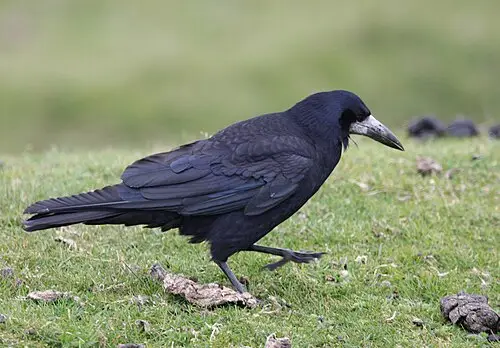
 📸 Photo
Photo: Brian Snelson from Hockley, Essex, England · CC BY 2.0 · Wikimedia Commons Source
Rook
Corvus frugilegus (Rook · ミヤマガラス)
💡 Everyday Comparisons for Size, Mass & Speed
- 💡 Its mass of 531 g is similar to one 500 mL bottle of water (about 500 g) (Comparison).
- 💡 Large flocks can be seen in the southern part of the Korean Peninsula during winter (National List of Species of Korea).
- 💡 Studies suggest that 60–90% of the insects it eats may be agricultural pests, so it may help reduce farm pests (ADW).
Reference standards: coach bus ~12 m, mid-size car ~4.9 m, compact car ~1 t, basketball hoop 3.05 m, credit card 8.56 cm.
Site-computed relative index from recorded values; not a formal scientific metric.
📖 1. Overview
The rook is a crow species that forms large flocks; in Korea it is both a winter visitor in the south and a passage migrant in spring and autumn.
🦴 2. Anatomy & Morphology
Its entire body is glossy metallic black with a strong purplish sheen in winter plumage. Greyish bare skin is exposed around the nostrils and base of the bill, the bill is slimmer than that of the carrion crow and gently curved, and the tail is wedge-shaped.
🔍 3. Ecology & Behavior
An opportunistic omnivore, it probes the ground with its bill for earthworms and insects and also eats acorns, grains, small animals, and carrion. It nests in colonies high in tall trees and lays 3–5 eggs in March–May (months 3–5).
🇰🇷 4. Connection to Korea
According to the National List of Species of Korea, it is a common passage migrant across Korea in spring and autumn, and large flocks spend the winter in the southern regions.
📚 Sources & References
- • IUCN Red List LC (2025) — https://www.iucnredlist.org/species/22705983/154484620
- • IUCN Red List category LC — latest assessment at iucnredlist.org
- • doi.org — avilist.v2026
- • iucnredlist.org — 154484620
- • 국가생물종목록(국립생물자원관) ktsn 120000001965 — https://species.nibr.go.kr/home/mainHome.do?cont_link=009&subMenu=009002&contCd=009002&ktsn=120000001965
- • wikidata.org — Q25386
- • commons.wikimedia.org — File:Corvus frugilegus -Dartmoor, Devon, England-8.jpg
- • animaldiversity.org — Corvus frugilegus
- • species.nibr.go.kr — mainHome.do
- • Silhouette: PhyloPic — Steven Traver · CC0 1.0
Recorded dimensions are widely cited representative estimates from public literature and may vary by study or specimen.