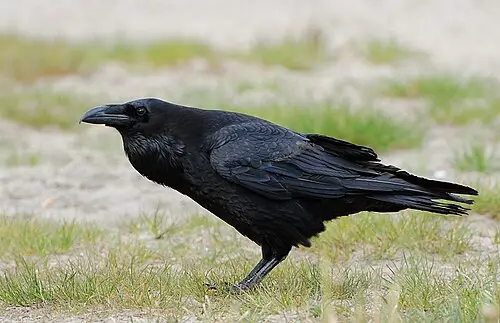
 📸 Photo
Photo: Accipiter (R. Altenkamp, Berlin) · CC BY-SA 3.0 · Wikimedia Commons Source
Northern Raven
Corvus corax (Northern Raven · ワタリガラス)
💡 Everyday Comparisons for Size, Mass & Speed
- 💡 Its body length of 69 cm is slightly shorter than a baseball bat (about 84 cm) (Comparison).
- 💡 Its mass of 1.6 kg is slightly heavier than one 1.5 L bottle of water (Comparison).
- 💡 By eating carrion, it helps remove dead animals that could spread disease (ADW).
Reference standards: coach bus ~12 m, mid-size car ~4.9 m, compact car ~1 t, basketball hoop 3.05 m, credit card 8.56 cm.
Site-computed relative index from recorded values; not a formal scientific metric.
📖 1. Overview
The northern raven is the largest bird in the order Passeriformes, a clever all-black corvid with a wedge-shaped tail.
🦴 2. Anatomy & Morphology
It has a well-developed ruff of throat feathers called 'hackles,' a wedge-shaped tail, and a stout bill. Larger than other Corvus species, it glides and soars on outstretched wings and gives a harsh croaking call.
🔍 3. Ecology & Behavior
Mainly a scavenger feeding on carrion, it also eats arthropods, amphibians, small mammals, birds, reptiles, grains, acorns, and fruits, and caches food. Pairs stay together year-round and lay eggs between mid-February (month 2) and late May (month 5).
🇰🇷 4. Connection to Korea
It is listed on the National List of Species of Korea as a species recorded in Korea under the name Keun-kkamagwi (Korean name).
📚 Sources & References
- • IUCN Red List LC (2025) — https://www.iucnredlist.org/species/22706068/281841771
- • IUCN Red List category LC — latest assessment at iucnredlist.org
- • doi.org — avilist.v2026
- • iucnredlist.org — 281841771
- • 국가생물종목록(국립생물자원관) ktsn 120000001968 — https://species.nibr.go.kr/home/mainHome.do?cont_link=009&subMenu=009002&contCd=009002&ktsn=120000001968
- • wikidata.org — Q25357
- • commons.wikimedia.org — File:Corvus corax ad berlin 090516.jpg
- • animaldiversity.org — Corvus corax
- • Silhouette: PhyloPic — Andy Wilson · CC0 1.0
Recorded dimensions are widely cited representative estimates from public literature and may vary by study or specimen.