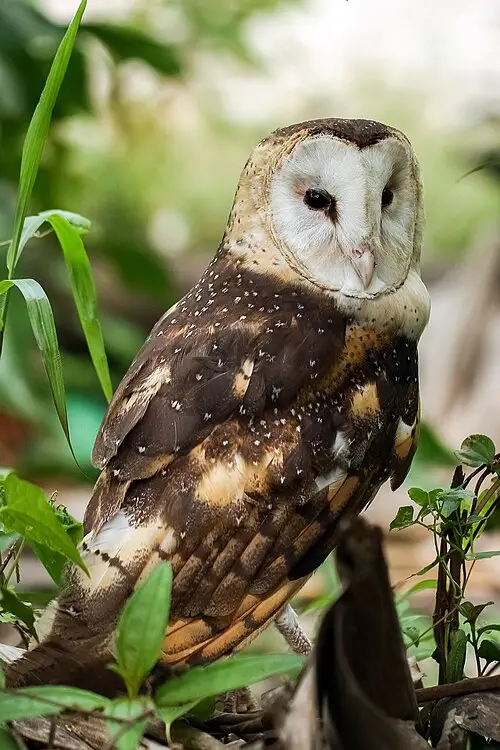
 📸 Photo
Photo: Ronny Overhate · CC0 · Wikimedia Commons Source
Eastern Grass Owl
Tyto longimembris (Eastern Grass Owl · ヒガシメンフクロウ)
💡 Everyday Comparisons for Size, Mass & Speed
- 💡 Its body length of 38 cm is nearly a handspan longer than the long side of an A4 sheet of paper (about 30 cm), and its maximum weight of 582 g is about the weight of ten chicken eggs (Comparison).
- 💡 Because it feeds mainly on rodents such as rats, some individuals may starve when prey becomes scarce around farmlands (The Peregrine Fund).
- 💡 Chicks hatch covered in white down and leave the nest after about two months (The Peregrine Fund).
Reference standards: coach bus ~12 m, mid-size car ~4.9 m, compact car ~1 t, basketball hoop 3.05 m, credit card 8.56 cm.
Site-computed relative index from recorded values; not a formal scientific metric.
📖 1. Overview
The Eastern Grass Owl is an owl living in open grasslands of southern Asia and Oceania, including Australia, Papua New Guinea, Indonesia, and the Philippines. It hides in tall grass and breeds on the ground.
🦴 2. Anatomy & Morphology
Its body length is 32–38 cm, its wingspan is 112 cm, and its weight is 265–582 g.
🔍 3. Ecology & Behavior
It feeds mainly on rodents and also catches marsupials, ground-dwelling birds, reptiles, frogs, and large insects such as grasshoppers. Like a harrier, it hunts by gliding low over the ground. Without building a tree nest, it lays 3–8 eggs on the ground hidden under tall grass and incubates them for about a month.
🇰🇷 4. Connection to Korea
It is listed under the name 'Gamyeon-olppaemi' (Korean name) in the National List of Species of Korea.
📚 Sources & References
- • IUCN Red List LC (2024) — https://www.iucnredlist.org/species/22688522/263684657
- • IUCN Red List category LC — latest assessment at iucnredlist.org
- • doi.org — avilist.v2026
- • iucnredlist.org — 263684657
- • 국가생물종목록(국립생물자원관) ktsn 120000155189 — https://species.nibr.go.kr/home/mainHome.do?cont_link=009&subMenu=009002&contCd=009002&ktsn=120000155189
- • wikidata.org — Q306919
- • commons.wikimedia.org — File:Eastern-grass-owl-1134817.jpg
- • peregrinefund.org — eastern-grass-owl
- • Silhouette: PhyloPic — Sharon Wegner-Larsen · CC0 1.0 (Congeneric silhouette — Tyto alba)
Recorded dimensions are widely cited representative estimates from public literature and may vary by study or specimen.