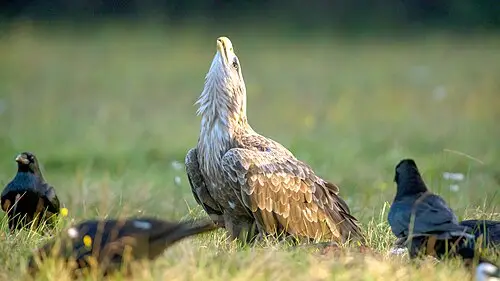
 📸 Photo
Photo: Original: Andreas Weith . This edit: MPF . · CC BY-SA 4.0 · Wikimedia Commons Source
White-tailed Eagle
Haliaeetus albicilla (White-tailed Eagle · オジロワシ)
🇰🇷 Class I endangered wildlife (Korea) · Natural Monument (Korea) «White-tailed Eagle»
💡 Everyday Comparisons for Size, Mass & Speed
- 💡 Its wingspan of 2.44 m is longer than the width of a passenger car (about 1.8 m) (Comparison).
- 💡 Because it spends time near fish farms and scavenges scraps left by anglers, it often stays close to food left by people along the water.
Reference standards: coach bus ~12 m, mid-size car ~4.9 m, compact car ~1 t, basketball hoop 3.05 m, credit card 8.56 cm.
Site-computed relative index from recorded values; not a formal scientific metric.
📖 1. Overview
The White-tailed Eagle is a large eagle living along rivers, lakes, and coasts of Eurasia whose tail turns white when fully grown.
🦴 2. Anatomy & Morphology
Its tail does not become fully white until about 8 years of age, and its flight is relatively slow and heavy, gliding less often than other large raptors.
🔍 3. Ecology & Behavior
It catches fish near the water surface (without plunging underwater like an Osprey), and also eats waterbirds such as ducks and gulls, hares, Common Muskrats, and carrion. It builds a large stick nest in a tall tree or on a rocky cliff, adding to it year after year, and lays 1–3 eggs.
🇰🇷 4. Connection to Korea
In Korea, it is a Class I endangered wildlife species (Korea) and was designated as a Natural Monument (Korea) on April 12, 1973.
📚 Sources & References
- • IUCN Red List LC (2021) — https://www.iucnredlist.org/species/22695137/206723035
- • 멸종위기 야생생물 Ⅰ급 · 천연기념물 «흰꼬리수리» — 국가생물종목록(국립생물자원관) ktsn 120000001587 — https://species.nibr.go.kr/home/mainHome.do?cont_link=009&subMenu=009002&contCd=009002&ktsn=120000001587
- • IUCN Red List category LC — latest assessment at iucnredlist.org
- • Korean protection status: Class I endangered wildlife (Korea) · Natural Monument (Korea) «White-tailed Eagle»
- • doi.org — avilist.v2026
- • iucnredlist.org — 206723035
- • 국가생물종목록(국립생물자원관) ktsn 120000001587 — https://species.nibr.go.kr/home/mainHome.do?cont_link=009&subMenu=009002&contCd=009002&ktsn=120000001587
- • heritage.go.kr — culSelectDetail.do
- • wikidata.org — Q25438
- • commons.wikimedia.org — File:Adult White-tailed Eagle defending prey, Rezerwat Gosty
- • peregrinefund.org — white-tailed-sea-eagle
- • Silhouette: PhyloPic — Andy Wilson · CC0 1.0
Recorded dimensions are widely cited representative estimates from public literature and may vary by study or specimen.