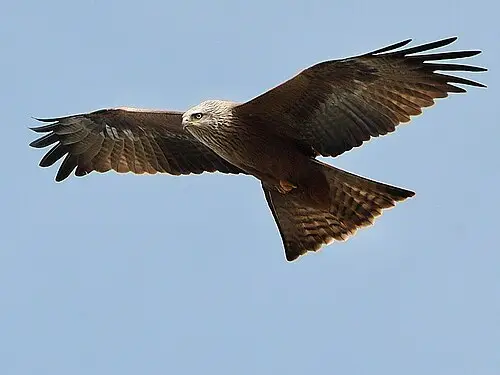
 📸 Photo
Photo: Thomas Kraft ( ThKraft ) · CC BY-SA 2.5 · Wikimedia Commons Source
Black Kite
Milvus migrans (Black Kite · トビ)
🇰🇷 Class II endangered wildlife (Korea)
💡 Everyday Comparisons for Size, Mass & Speed
- 💡 Its weight of 0.54 kg is similar to a 500 mL bottle of water (Comparison).
- 💡 Its maximum wingspan of 1.53 m is slightly shorter than the height of an adult human (about 1.6–1.7 m) (Comparison).
- 💡 It feeds on mice and roadkill, and sometimes appears even in large cities.
Reference standards: coach bus ~12 m, mid-size car ~4.9 m, compact car ~1 t, basketball hoop 3.05 m, credit card 8.56 cm.
Site-computed relative index from recorded values; not a formal scientific metric.
📖 1. Overview
The Black Kite is a medium-sized bird of prey with a forked, swallow-like tail tip, living widely from open waterfronts to rural areas and large cities.
🦴 2. Anatomy & Morphology
The body is mostly brown with a paler head, and its large black hooked bill has a yellow cere. The wingtips are separated like fingers, and the tail is forked.
🔍 3. Ecology & Behavior
It eats a wide range of food, including birds, mammals such as mice, amphibians, reptiles, fish, insects, eggs, and carrion. It breeds from March to August, usually laying 2–3 eggs, and the young leave the nest at 42–56 days.
🇰🇷 4. Connection to Korea
In Korea, it is designated as Class II endangered wildlife (Korea).
📚 Sources & References
- • IUCN Red List LC (2021) — https://www.iucnredlist.org/species/181568721/206588554
- • 멸종위기 야생생물 Ⅱ급 — 국가생물종목록(국립생물자원관) ktsn 120000001585 — https://species.nibr.go.kr/home/mainHome.do?cont_link=009&subMenu=009002&contCd=009002&ktsn=120000001585
- • IUCN Red List category LC — latest assessment at iucnredlist.org
- • Korean protection status: Class II endangered wildlife (Korea)
- • doi.org — avilist.v2026
- • iucnredlist.org — 206588554
- • 국가생물종목록(국립생물자원관) ktsn 120000001585 — https://species.nibr.go.kr/home/mainHome.do?cont_link=009&subMenu=009002&contCd=009002&ktsn=120000001585
- • wikidata.org — Q80362
- • commons.wikimedia.org — File:Milvus migrans front(ThKraft).jpg
- • nie.re.kr — view.do
- • animaldiversity.org — Milvus migrans
- • Silhouette: PhyloPic — Andy Wilson · CC0 1.0
Recorded dimensions are widely cited representative estimates from public literature and may vary by study or specimen.