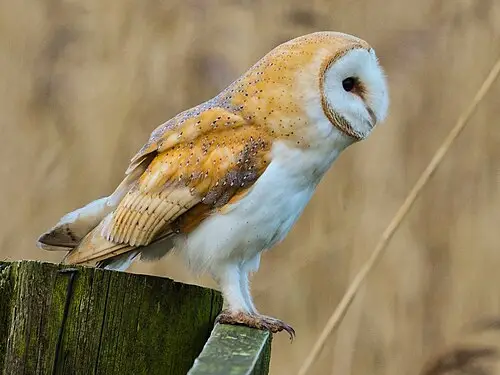
 📸 Photo
Photo: User:Alun Williams333 · CC BY-SA 4.0 · Wikimedia Commons Source
Western Barn Owl
Tyto alba (Western Barn Owl · メンフクロウ)
💡 Everyday Comparisons for Size, Mass & Speed
- 💡 By nesting in barns, church steeples, and nest boxes put up by people, it lives close to human settlements.
- 💡 It preys mainly on mice and voles.
- 💡 Its weight of 0.62 kg is slightly heavier than a 500 mL bottle of water (Comparison).
Reference standards: coach bus ~12 m, mid-size car ~4.9 m, compact car ~1 t, basketball hoop 3.05 m, credit card 8.56 cm.
Site-computed relative index from recorded values; not a formal scientific metric.
📖 1. Overview
The Western Barn Owl is a medium-sized owl living in open country across much of the world, also nesting in places such as barns and church towers.
🦴 2. Anatomy & Morphology
It has a large, round head without ear tufts, rounded wings, a short tail, and long, sparsely feathered legs. Its upperparts are pale brown speckled with black and white, its underparts are grayish-white, and its asymmetrically placed ears help it locate prey by sound.
🔍 3. Ecology & Behavior
It catches small mammals such as mice, voles, shrews, and lagomorphs with its feet and swallows them whole. It usually pairs for life, breeds year-round when prey is plentiful, and commonly lays 4–7 eggs.
🇰🇷 4. Connection to Korea
No direct record connecting this species to Korea has been found.
📚 Sources & References
- • IUCN Red List LC (2025) — https://www.iucnredlist.org/species/22688504/280909370
- • IUCN Red List category LC — latest assessment at iucnredlist.org
- • doi.org — avilist.v2026
- • iucnredlist.org — 280909370
- • wikidata.org — Q25317
- • commons.wikimedia.org — File:Tyto alba tylluan wen detail.jpg
- • animaldiversity.org — Tyto alba
- • Silhouette: PhyloPic — Sharon Wegner-Larsen · CC0 1.0
Recorded dimensions are widely cited representative estimates from public literature and may vary by study or specimen.