 📸 Photo
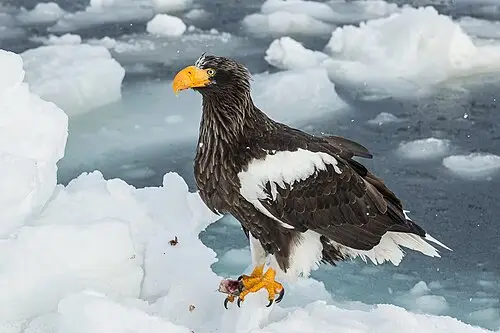
Photo: Michael Pinczolits · CC BY 2.0 · Wikimedia Commons Source
Steller's Sea Eagle
Haliaeetus pelagicus (Steller's Sea Eagle · オオワシ)
🇰🇷 Class I endangered wildlife (Korea) · Natural Monument (Korea) «Steller's Sea Eagle»
💡 Everyday Comparisons for Size, Mass & Speed
- 💡 A wingspan of 2.45 m is longer than the height of a front door (about 2 m) (Comparison).
- 💡 A weight of 9 kg is slightly lighter than a 10 kg bag of rice (Comparison).
- 💡 The salmon it mainly feeds on belong to the same group of fish as the salmon seen in supermarkets and restaurants.
Reference standards: coach bus ~12 m, mid-size car ~4.9 m, compact car ~1 t, basketball hoop 3.05 m, credit card 8.56 cm.
Site-computed relative index from recorded values; not a formal scientific metric.
📖 1. Overview
Steller's sea eagle is a very large eagle living along seacoasts and large river estuaries in Northeast Asia, with white shoulders, thighs, and forehead and a large yellow beak.
🦴 2. Anatomy & Morphology
Its body is dark brown with a wedge-shaped white tail, and it has sharp yellow talons. Females are larger than males.
🔍 3. Ecology & Behavior
It feeds mainly on live or dead salmon, and when salmon are scarce it also eats crabs, mussels, gulls, small mammals, and carrion. It builds a nest about 2 m wide on rocky cliffs or atop large trees and usually lays 2 eggs.
🇰🇷 4. Connection to Korea
In Korea, it is listed as Class I endangered wildlife (Korea) and was designated a Natural Monument (Korea) on April 12, 1973 (1973-04-12).
📚 Sources & References
- • IUCN Red List VU (2021) — https://www.iucnredlist.org/species/22695147/204871862
- • 멸종위기 야생생물 Ⅰ급 · 천연기념물 «참수리» — 국가생물종목록(국립생물자원관) ktsn 120000001588 — https://species.nibr.go.kr/home/mainHome.do?cont_link=009&subMenu=009002&contCd=009002&ktsn=120000001588
- • IUCN Red List category VU — latest assessment at iucnredlist.org
- • Korean protection status: Class I endangered wildlife (Korea) · Natural Monument (Korea) «Steller's Sea Eagle»
- • doi.org — avilist.v2026
- • iucnredlist.org — 204871862
- • 국가생물종목록(국립생물자원관) ktsn 120000001588 — https://species.nibr.go.kr/home/mainHome.do?cont_link=009&subMenu=009002&contCd=009002&ktsn=120000001588
- • heritage.go.kr — culSelectDetail.do
- • wikidata.org — Q269896
- • commons.wikimedia.org — File:Haliaeetus pelagicus (Rausu, Japan).jpg
- • nie.re.kr — view.do
- • animaldiversity.org — Haliaeetus pelagicus
- • Silhouette: PhyloPic — Steve Hillebrand/U. S. Fish and Wildlife Service (source photo), T. Michael Keesey (vectorization) · Public Domain Mark 1.0 (Congeneric silhouette — Haliaeetus leucocephalus)
Recorded dimensions are widely cited representative estimates from public literature and may vary by study or specimen.