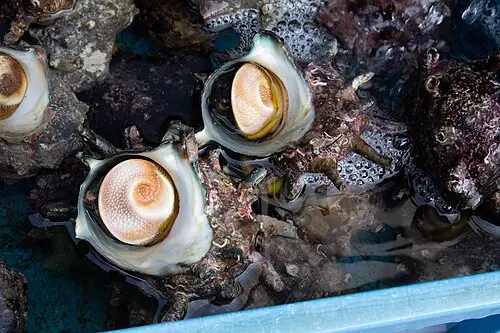
 📸 Photo
Photo: Σ64 · CC BY 4.0 · Wikimedia Commons Source
Japanese turbo snail
Turbo sazae (Japanese turbo snail · サザエ)
Not Evaluated (NE) on the IUCN Red List yet.
💡 Everyday Comparisons for Size, Mass & Speed
- 💡 Its maximum height of 10 cm is slightly longer than the long side of a credit card (about 8.6 cm) (Comparison).
- 💡 Alongside abalone, it is a mollusk of great value as seafood and is harvested in large quantities in Jeju Island (National List of Species of Korea).
- 💡 Because its shell bears long horn-like spines, it is also called Ppul-sora (Korean name, meaning 'horned turban shell') (National List of Species of Korea).
Reference standards: coach bus ~12 m, mid-size car ~4.9 m, compact car ~1 t, basketball hoop 3.05 m, credit card 8.56 cm.
📖 1. Overview
The Japanese turbo snail is a large sea snail living in rocky areas of the East Sea, the South Sea, and Jeju Island, and has great value as seafood alongside abalone.
🦴 2. Anatomy & Morphology
Its shell is thick and hard with 7 whorls, each showing distinct growth lines and long, hollow horn-like spines. The inner rim of the aperture is white with pearly luster, and the operculum is calcareous.
🔍 3. Ecology & Behavior
It feeds on diatoms and brown algae on the surfaces of rocks and seaweeds. It releases eggs and sperm mainly in August–September, and its planktonic larval stage is short at about 5 days.
🇰🇷 4. Connection to Korea
It is listed on the National List of Species of Korea under the name Sora (Korean name) and lives in the East Sea, the South Sea, and Jeju Island. Production is especially high in Jeju Island.
📚 Sources & References
- • IUCN Red List: not evaluated (NE) — cross-checked with the Wikidata conservation-status entry
- • marinespecies.org — aphia.php
- • 국가생물종목록(국립생물자원관) ktsn 120000131391 — https://species.nibr.go.kr/home/mainHome.do?cont_link=009&subMenu=009002&contCd=009002&ktsn=120000131391
- • wikidata.org — Q60452494
- • species.nibr.go.kr — mainHome.do
- • Silhouette: PhyloPic — Tauana J. Cunha · CC0 1.0 (Congeneric silhouette — Turbo argyrostomus)
Recorded dimensions are widely cited representative estimates from public literature and may vary by study or specimen.