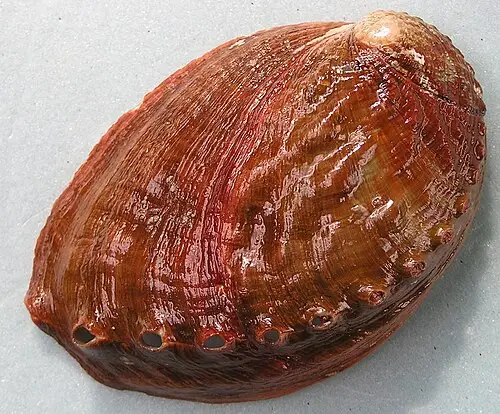
 📸 Photo
Photo: Jan Delsing · Public domain · Wikimedia Commons Source
Disk abalone
Haliotis discus (Disk abalone · Disk abalone)
💡 Everyday Comparisons for Size, Mass & Speed
- 💡 Abalone porridge (Jeonbokjuk), made by simmering rice in broth boiled with fresh abalone, is prepared at a ratio of about 5 medium-sized abalones to 1 cup of rice (Encyclopedia of Korean Culture).
- 💡 Abalone is a seafood that has been eaten since ancient times, appearing even in prehistoric shell mounds (Encyclopedia of Korean Culture).
- 💡 Its shell length of 20 cm is almost the same as the short side of an A4 sheet of paper (21 cm).
Reference standards: coach bus ~12 m, mid-size car ~4.9 m, compact car ~1 t, basketball hoop 3.05 m, credit card 8.56 cm.
📖 1. Overview
The disk abalone is a large gastropod living in seaweed forests on rocky seafloors and is distributed along all coasts of Korea. Its northern form is called 'Chamjeonbok' in Korean fisheries.
🦴 2. Anatomy & Morphology
The outer shell is brownish green with a strong blackish tint, wavy wrinkles, and radial ribs, while the inside has a strong pearly luster. A row of raised holes runs along the dorsal margin, with only the last 4–5 open as respiratory pores.
🔍 3. Ecology & Behavior
It spawns in autumn, and the eggs are fertilized in seawater and drift for 3–7 days before transitioning to a bottom-crawling life. Once on the bottom, juveniles eat tiny algae such as benthic diatoms and switch to large seaweeds as they grow.
🇰🇷 4. Connection to Korea
Seedlings for aquaculture have been produced at the National Fisheries Research and Development Agency hatcheries since the 1960s, and it is an ancient edible seafood found even in prehistoric shell mounds. It is assessed as Endangered (EN, 2022) on the IUCN Red List.
📚 Sources & References
- • IUCN Red List EN (2022) — https://www.iucnredlist.org/species/78764186/78772433
- • IUCN Red List category EN — latest assessment at iucnredlist.org
- • marinespecies.org — aphia.php
- • iucnredlist.org — 78772433
- • 국가생물종목록(국립생물자원관) ktsn 120000131303 — https://species.nibr.go.kr/home/mainHome.do?cont_link=009&subMenu=009002&contCd=009002&ktsn=120000131303
- • wikidata.org — Q3011996
- • commons.wikimedia.org — File:Haliotis discus.jpg
- • encykorea.aks.ac.kr — E0049430
- • encykorea.aks.ac.kr — E0049433
- • Silhouette: PhyloPic — Tauana J. Cunha · CC0 1.0 (Congeneric silhouette — Haliotis)
Recorded dimensions are widely cited representative estimates from public literature and may vary by study or specimen.