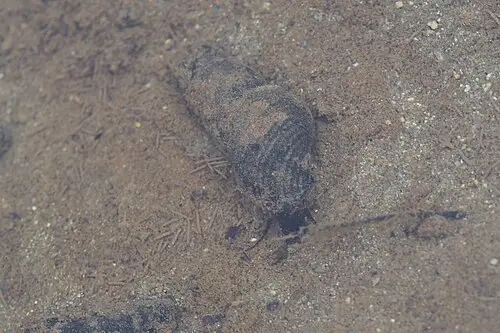
 📸 Photo
Photo: harum.koh from Kobe city, Japan · CC BY-SA 2.0 · Wikimedia Commons Source
Semisulcospira libertina
Semisulcospira libertina (Semisulcospira libertina · カワニナ)
💡 Everyday Comparisons for Size, Mass & Speed
- 💡 Its shell height of 25 mm is almost the same as the diameter of a Korean 500-won coin (about 2.65 cm) (Comparison).
- 💡 It is widely used for food (National List of Species of Korea).
Reference standards: coach bus ~12 m, mid-size car ~4.9 m, compact car ~1 t, basketball hoop 3.05 m, credit card 8.56 cm.
📖 1. Overview
Semisulcospira libertina is a small freshwater snail found in ponds, rivers, and streams in Korea, and is also called Godong (Korean name).
🦴 2. Anatomy & Morphology
Its shell is yellowish-brown, and some individuals have reddish-brown bands. It has 5–6 whorls, though erosion often leaves only 3–4 whorls, and its shape varies greatly depending on its habitat.
🔍 3. Ecology & Behavior
It is especially easy to spot in deep rivers with strong currents. It is a benthic freshwater species recorded in freshwaters of Korea, Taiwan, and the Ryukyu Islands.
🇰🇷 4. Connection to Korea
It is listed on the National List of Species of Korea under the name Daseulgi (Korean name) and lives throughout the Korean Peninsula. It is widely used for food.
📚 Sources & References
- • IUCN Red List LC (2014) — https://www.iucnredlist.org/species/166281/1127046
- • IUCN Red List category LC — latest assessment at iucnredlist.org
- • catalogueoflife.org — 6YFWW
- • iucnredlist.org — 1127046
- • 국가생물종목록(국립생물자원관) ktsn 120000041938 — https://species.nibr.go.kr/home/mainHome.do?cont_link=009&subMenu=009002&contCd=009002&ktsn=120000041938
- • wikidata.org — Q8000629
- • commons.wikimedia.org — File:Semisulcospira libertina.jpg
- • species.nibr.go.kr — mainHome.do
- • sealifebase.se — Semisulcospira-libertina.html
Recorded dimensions are widely cited representative estimates from public literature and may vary by study or specimen.