 📸 Photo
Photo: MerlinCharon · Public domain · Wikimedia Commons Source
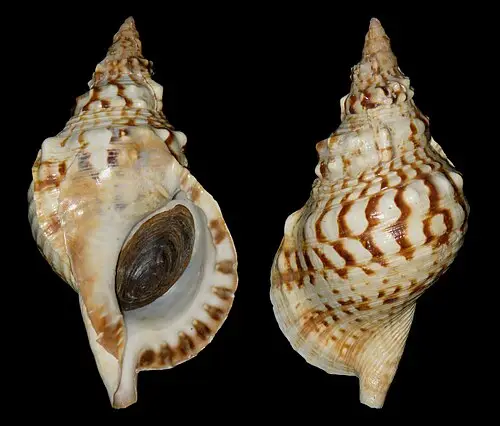
Knobbed triton
Charonia lampas (Knobbed triton · ボウシュウボラ)
Not Evaluated (NE) on the IUCN Red List yet.
🇰🇷 Class I endangered wildlife (Korea)
💡 Everyday Comparisons for Size, Mass & Speed
- 💡 Its shell has been used as an ornament and its flesh as food, and overharvesting is a cause of its population decline (National Institute of Ecology).
- 💡 Its maximum length of 39 cm is about 1.3 times longer than the long side of an A4 sheet of paper (29.7 cm) (Comparison).
Reference standards: coach bus ~12 m, mid-size car ~4.9 m, compact car ~1 t, basketball hoop 3.05 m, credit card 8.56 cm.
📖 1. Overview
The knobbed triton is the largest marine snail in Korea, living in the seas around Jeju Island and the South Sea coast.
🦴 2. Anatomy & Morphology
Its shell is very hard and thick, with irregular reddish-brown markings scattered over a yellowish-white background. The aperture is a large, elongated oval with a thick outer lip.
🔍 3. Ecology & Behavior
It mainly preys on starfish, and around Jeju Island it favors Ppalgangbulgasari (a Korean starfish name). Sexes are separate, fertilization is internal, and eggs are laid from December to April.
🇰🇷 4. Connection to Korea
It is designated as Class I endangered wildlife (Korea) and is distributed mainly along the coasts of Jeju Island and the South Sea. Overharvesting for food is cited as a factor in its population decline.
📚 Sources & References
- • 멸종위기 야생생물 Ⅰ급 — 국가생물종목록(국립생물자원관) ktsn 120000042136 — https://species.nibr.go.kr/home/mainHome.do?cont_link=009&subMenu=009002&contCd=009002&ktsn=120000042136
- • IUCN Red List: not evaluated (NE) — cross-checked with the Wikidata conservation-status entry
- • Korean protection status: Class I endangered wildlife (Korea)
- • marinespecies.org — aphia.php
- • 국가생물종목록(국립생물자원관) ktsn 120000042136 — https://species.nibr.go.kr/home/mainHome.do?cont_link=009&subMenu=009002&contCd=009002&ktsn=120000042136
- • wikidata.org — Q1315928
- • commons.wikimedia.org — File:Charonia lampas nodifera 20 a.jpg
- • sealifebase.se — Charonia-lampas.html
- • nie.re.kr — view.do
Recorded dimensions are widely cited representative estimates from public literature and may vary by study or specimen.