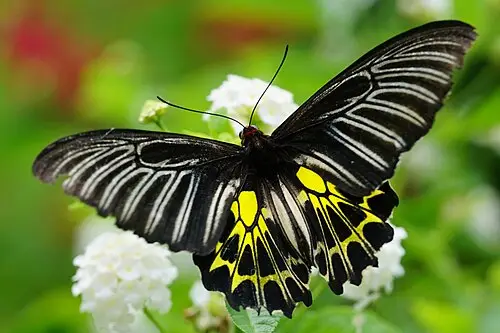
 📸 Photo
Photo: Peellden · CC BY-SA 4.0 · Wikimedia Commons Source
Golden birdwing
Troides aeacus (Golden birdwing · Golden birdwing)
💡 Everyday Comparisons for Size, Mass & Speed
- 💡 Its 20 cm wingspan is almost equal to the short side of an A4 sheet of paper (21 cm) (Comparison).
- 💡 According to a guide from Taiwan's Forestry Bureau, all species in this genus are listed in CITES Appendix II, and the Taiwanese subspecies is protected as Class II under Taiwan's Wildlife Conservation Act.
Reference standards: coach bus ~12 m, mid-size car ~4.9 m, compact car ~1 t, basketball hoop 3.05 m, credit card 8.56 cm.
📖 1. Overview
The golden birdwing is a large birdwing butterfly widely distributed in East Asia, with contrasting yellow hindwings and a black body. The IUCN assessed it as Least Concern (LC) in 2020.
🦴 2. Anatomy & Morphology
Based on the Taiwanese subspecies, the forewing span is 13–20 cm. The head and thorax are black with red hairs on the sides of the thorax, and the abdomen is bright yellow with black spots.
🔍 3. Ecology & Behavior
Larvae feed on pipevines (Aristolochia), and adults fly high in the sky or above the forest canopy in the early morning and late afternoon to visit flowers of various plants for nectar. Eggs are laid singly on the underside of leaves. In Taiwan, activity peaks in March–April and July–August.
🇰🇷 4. Connection to Korea
No direct record connecting this species to Korea has been found.
📚 Sources & References
- • IUCN Red List LC (2020) — https://www.iucnredlist.org/species/62160/177265323
- • IUCN Red List category LC — latest assessment at iucnredlist.org
- • catalogueoflife.org — 7D82Z
- • iucnredlist.org — 177265323
- • wikidata.org — Q702952
- • commons.wikimedia.org — File:Troides aeacus formosanus female back.jpg
- • subjectweb.forest.gov.tw — insect 80.htm
- • subjectweb.forest.gov.tw — insect 54.htm
- • Silhouette: PhyloPic — Andy Wilson · CC0 1.0 (Related taxon silhouette — Papilio troilus)
Recorded dimensions are widely cited representative estimates from public literature and may vary by study or specimen.