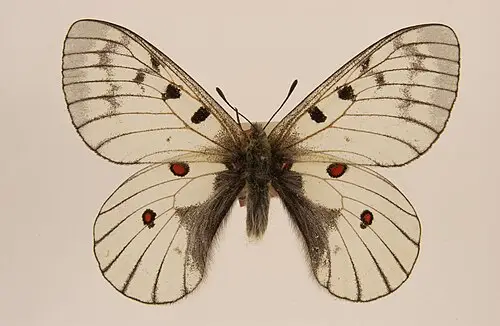
 📸 Photo
Photo: Robert Nash · CC BY-SA 2.5 · Wikimedia Commons Source
Red-spotted apollo
Parnassius bremeri (Red-spotted apollo · アカボシウスバシロチョウ)
Not Evaluated (NE) on the IUCN Red List yet.
🇰🇷 Class I endangered wildlife (Korea)
💡 Everyday Comparisons for Size, Mass & Speed
- 💡 A maximum wingspan of 75 mm is about 2.8 times the diameter of a Korean 500-won coin (26.5 mm) (Comparison).
- 💡 Adults sip nectar from flowers such as bramble, thistle, and stonecrop. Shrinking grasslands and indiscriminate collecting are cited as reasons for its decline.
Reference standards: coach bus ~12 m, mid-size car ~4.9 m, compact car ~1 t, basketball hoop 3.05 m, credit card 8.56 cm.
📖 1. Overview
The red-spotted apollo is a white butterfly in the apollo group that appears once in spring, marked with red spots on its hindwings. It is a Class I endangered wildlife species in Korea.
🦴 2. Anatomy & Morphology
With a wingspan of 65–75 mm, it is relatively large among apollo butterflies, having black markings on white forewings and red spots ringed in black on the hindwings. It resembles Mosi-nabi (a Korean butterfly name), which lacks red spots, and is distinguished by these spots.
🔍 3. Ecology & Behavior
Adults are seen from late April to early May and disappear by late May, and females attach eggs singly onto dry leaves, stems, and stones near their host plants. Because the larvae feed only on Sedum (stonecrop) plants, its habitat is very limited.
🇰🇷 4. Connection to Korea
It is a Class I endangered wildlife species (Korea). It is distributed only in a few areas such as Samcheok and Jeongseon in Gangwon-do and Yeongju and Uiseong in Gyeongsangbuk-do.
📚 Sources & References
- • 멸종위기 야생생물 Ⅰ급 — 국가생물종목록(국립생물자원관) ktsn 120000035922 — https://species.nibr.go.kr/home/mainHome.do?cont_link=009&subMenu=009002&contCd=009002&ktsn=120000035922
- • IUCN Red List: not evaluated (NE) — cross-checked with the Wikidata conservation-status entry
- • Korean protection status: Class I endangered wildlife (Korea)
- • catalogueoflife.org — 763CK
- • 국가생물종목록(국립생물자원관) ktsn 120000035922 — https://species.nibr.go.kr/home/mainHome.do?cont_link=009&subMenu=009002&contCd=009002&ktsn=120000035922
- • wikidata.org — Q842225
- • commons.wikimedia.org — File:Parnassius bremeri1934 ulster.jpg
- • nie.re.kr — view.do
- • bok.or.kr — contents.do
- • Silhouette: PhyloPic — Andy Wilson · CC0 1.0 (Congeneric silhouette — Parnassius apollo)
Recorded dimensions are widely cited representative estimates from public literature and may vary by study or specimen.