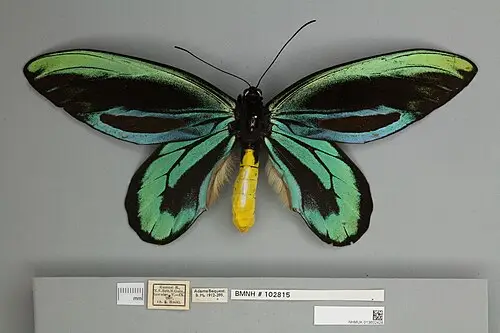
 📸 Photo
Photo: Peter Wing · CC BY 4.0 · Wikimedia Commons Source
Queen Alexandra's birdwing
Ornithoptera alexandrae (Queen Alexandra's birdwing · アレクサンドラトリバネアゲハ)
💡 Everyday Comparisons for Size, Mass & Speed
- 💡 The largest recorded wingspan of 27.3 cm is more than 6 cm longer than the short side of an A4 sheet of paper (21 cm) (Comparison).
- 💡 Named after Queen Alexandra of the United Kingdom, both the first described specimen (wingspan nearly 20 cm) and the largest specimen (27.3 cm) are housed at the Natural History Museum in London.
Reference standards: coach bus ~12 m, mid-size car ~4.9 m, compact car ~1 t, basketball hoop 3.05 m, credit card 8.56 cm.
📖 1. Overview
Queen Alexandra's birdwing is a birdwing butterfly regarded as the largest butterfly in the world, and is an endangered species living in the tropical rainforests of northern Papua New Guinea.
🦴 2. Anatomy & Morphology
Females are much larger than males, reaching a wingspan of about 27 cm, and have cream-colored markings on a brown background with a yellow abdomen. Males are bright green.
🔍 3. Ecology & Behavior
The Natural History Museum in London explains that because of its large size, this butterfly can pollinate large plants that other insects cannot. Its habitat is rapidly disappearing due to logging for oil palm plantations, and the IUCN assessed it as Endangered (EN) in 2018.
🇰🇷 4. Connection to Korea
No direct record connecting this species to Korea has been found.
📚 Sources & References
- • IUCN Red List EN (2018) — https://www.iucnredlist.org/species/15513/88565197
- • IUCN Red List category EN — latest assessment at iucnredlist.org
- • catalogueoflife.org — 758B3
- • iucnredlist.org — 88565197
- • wikidata.org — Q932602
- • commons.wikimedia.org — File:013602428 Ornithoptera alexandrae dorsal male.jpg
- • nhm.ac.uk — record-breaking-butterflies.html
- • nhm.ac.uk — butterflies-with-bullet-holes.html
- • Silhouette: PhyloPic — Sara Gamboa · CC0 1.0 (Congeneric silhouette — Ornithoptera)
Recorded dimensions are widely cited representative estimates from public literature and may vary by study or specimen.