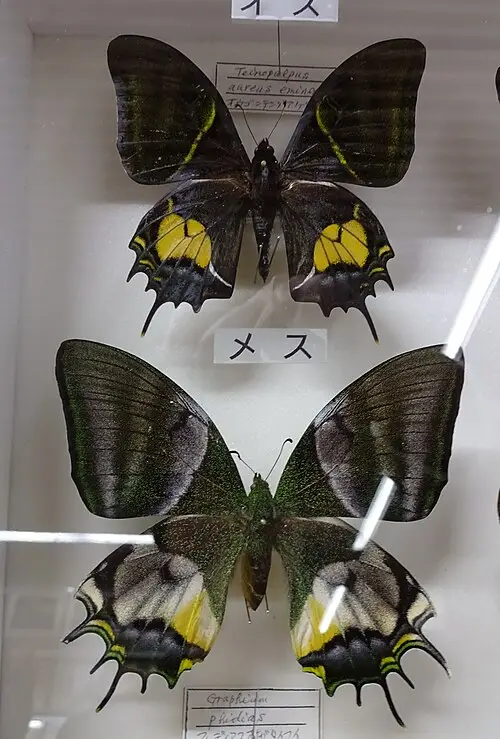
 📸 Photo
Photo: コミスジ空港 · CC BY-SA 4.0 · Wikimedia Commons Source
Golden Kaiser-i-Hind
Teinopalpus aureus (Golden Kaiser-i-Hind · Golden Kaiser-i-Hind)
💡 Everyday Comparisons for Size, Mass & Speed
- 💡 Its 10 cm wingspan is 1.4 cm longer than the long side of a credit card (8.56 cm) (Comparison).
- 💡 A guide from Taiwan's Forestry Bureau notes that deforestation and illegal collection threaten its populations, and the IUCN assessed it as Data Deficient (DD) in 1996.
Reference standards: coach bus ~12 m, mid-size car ~4.9 m, compact car ~1 t, basketball hoop 3.05 m, credit card 8.56 cm.
📖 1. Overview
The Golden Kaiser-i-Hind is a rare swallowtail butterfly living in southern China, Hainan Island, and Vietnam, assessed as Data Deficient (DD) by the IUCN.
🦴 2. Anatomy & Morphology
Its wingspan is 8–10 cm, much smaller than its closely related species (Kaijeonabi, a Korean butterfly name) and with more rounded forewing tips. The median band is metallic yellowish-green, and the underside of the hindwing is grayish-white.
🔍 3. Ecology & Behavior
After being described in 1923, its life history remained unknown for a long time until it was first reported in detail from Vietnam in 2001. The larvae appear to feed on Magnolia species; on Wuzhi Mountain in Hainan, adults fly around ridges at about 800 m elevation, and males show strong territorial behavior.
🇰🇷 4. Connection to Korea
No direct record connecting this species to Korea has been found.
📚 Sources & References
- • IUCN Red List DD (1996) — https://www.iucnredlist.org/species/21557/9301005
- • IUCN Red List category DD — latest assessment at iucnredlist.org
- • catalogueoflife.org — 7BMTW
- • iucnredlist.org — 9301005
- • wikidata.org — Q1937030
- • commons.wikimedia.org — File:551-Teinopalpus aureus- Museum of Kamei Collection.JPG
- • subjectweb.forest.gov.tw — insect 30.htm
- • Silhouette: PhyloPic — Andy Wilson · CC0 1.0 (Related taxon silhouette — Papilio troilus)
Recorded dimensions are widely cited representative estimates from public literature and may vary by study or specimen.