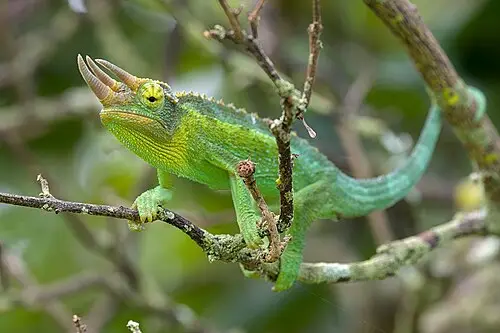
 📸 Photo
Photo: AMMuench · CC BY 4.0 · Wikimedia Commons Source
Jackson's Chameleon
Trioceros jacksonii (Jackson's Chameleon · ジャクソンカメレオン)
💡 Everyday Comparisons for Size, Mass & Speed
- 💡 Brought from Kenya and Tanzania to Hawaii in 1972 and released in Kaneohe, it spread and is now treated as an invasive species that eats native Hawaiian insects, spiders, and snails (Hawaii Invasive Species information).
- 💡 It holds relatively high value in the pet trade (positive impacts on humans in ADW).
- 💡 A male's length of about 10–12 inches (25–30 cm) is similar to a 30 cm ruler (State of Hawaii description, Comparison).
Reference standards: coach bus ~12 m, mid-size car ~4.9 m, compact car ~1 t, basketball hoop 3.05 m, credit card 8.56 cm.
📖 1. Overview
Jackson's Chameleon is an arboreal chameleon living in montane bushes and forests of East Africa including Kenya, notable for the three horns on the male's head.
🦴 2. Anatomy & Morphology
Most individuals measure 15–35 cm; males have three long horns on the forehead, while females have no horns or less developed ones. Each eye rotates 180 degrees and moves independently.
🔍 3. Ecology & Behavior
It mainly eats insects and spiders and gets water by licking droplets off leaves. It is ovoviviparous, giving birth to live young after a gestation of about 190 days, and newborns measure about 5.5 cm and weigh about 0.6 g.
🇰🇷 4. Connection to Korea
No direct record connecting this species to Korea has been found.
📚 Sources & References
- • IUCN Red List LC (2014) — https://www.iucnredlist.org/species/172531/109922526
- • IUCN Red List category LC — latest assessment at iucnredlist.org
- • catalogueoflife.org — 58VQK
- • iucnredlist.org — 109922526
- • wikidata.org — Q18599624
- • commons.wikimedia.org — File:Male Jackson's Chameleon - Big Island Hawaii June 12 20
- • animaldiversity.org — Chamaeleo jacksonii
- • dlnr.hawaii.gov — jacksons-chameleon
- • reptile-database.reptarium.cz — species
- • Silhouette: PhyloPic — author not recorded · CC0 1.0 (Related taxon silhouette — Brookesia brunoi)
Recorded dimensions are widely cited representative estimates from public literature and may vary by study or specimen.