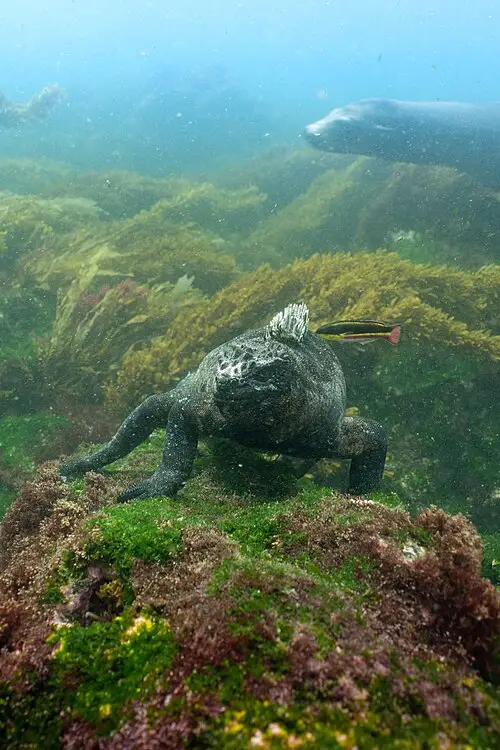
 📸 Photo
Photo: Sodacan · CC BY-SA 4.0 · Wikimedia Commons Source
Marine Iguana
Amblyrhynchus cristatus (Marine Iguana · ウミイグアナ)
💡 Everyday Comparisons for Size, Mass & Speed
- 💡 The 30–80 cm depth of its nesting burrow is equal to one to two and a half 30 cm rulers (Comparison).
- 💡 Hardly any people live on its islands and humans do not compete for its seaweed diet, but introduced rats, dogs, and cats threaten its eggs and adult females (ADW).
Reference standards: coach bus ~12 m, mid-size car ~4.9 m, compact car ~1 t, basketball hoop 3.05 m, credit card 8.56 cm.
📖 1. Overview
The Marine Iguana is a lizard that lives along the rocky shores of the volcanic Galápagos Islands and forages in the sea.
🦴 2. Anatomy & Morphology
Its body is gray to black with pyramid-shaped scales along the back. It has a shorter, blunter snout than land iguanas and a slightly laterally flattened tail, while juveniles have a paler dorsal stripe.
🔍 3. Ecology & Behavior
It feeds almost exclusively on marine algae. Larger individuals dive into the water at high tide to feed while smaller ones forage only in the intertidal zone at low tide, and because the sea water is cold, they must bask in the sun on land to warm their bodies. Females lay 1–6 eggs in burrows 30–80 cm deep.
🇰🇷 4. Connection to Korea
No direct record connecting this species to Korea has been found.
📚 Sources & References
- • IUCN Red List VU (2020) — https://www.iucnredlist.org/species/1086/177552193
- • IUCN Red List category VU — latest assessment at iucnredlist.org
- • catalogueoflife.org — 5TZN4
- • iucnredlist.org — 177552193
- • wikidata.org — Q208796
- • commons.wikimedia.org — File:Marine Iguana (Amblyrhynchus cristatus) feeding underwa
- • animaldiversity.org — Amblyrhynchus cristatus
- • Silhouette: PhyloPic — Jack Mayer Wood · CC0 1.0 (Related taxon silhouette — Iguana iguana)
Recorded dimensions are widely cited representative estimates from public literature and may vary by study or specimen.