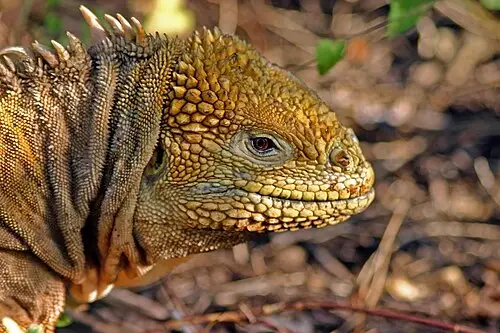
 📸 Photo
Photo: Charles J. Sharp · CC BY-SA 3.0 · Wikimedia Commons Source
Galápagos Land Iguana
Conolophus subcristatus (Galápagos Land Iguana · ガラパゴスリクイグアナ)
💡 Everyday Comparisons for Size, Mass & Speed
- 💡 Observed by Darwin in the early 19th century and influential in his theory of evolution, it remains an iconic Galápagos animal with ongoing research and conservation (ADW).
- 💡 A body length of 48 inches (about 122 cm) is about the height of a lower-grade elementary school child (Comparison).
- 💡 Females on Fernandina Island may travel more than 15 km to find a nesting site, a distance of three or four hours on foot (Comparison).
Reference standards: coach bus ~12 m, mid-size car ~4.9 m, compact car ~1 t, basketball hoop 3.05 m, credit card 8.56 cm.
📖 1. Overview
The Galápagos Land Iguana is a large yellow or brown lizard living on the dry islands of the Galápagos.
🦴 2. Anatomy & Morphology
Heavy-bodied and growing to over 48 inches (about 122 cm), it has thick hind legs and smaller front legs. A spiky crest runs along its neck and back, its toes bear long, sharp claws, and its tail is considerably longer than its trunk.
🔍 3. Ecology & Behavior
Largely herbivorous, it eats the fruits and pads of spiny prickly pear cacti by rolling them around in its mouth to work off the spines. Males defend territories around burrows, and females lay about 25 soft-shelled eggs in moist sand or under leaf litter.
🇰🇷 4. Connection to Korea
No direct record connecting this species to Korea has been found.
📚 Sources & References
- • IUCN Red List VU (2020) — https://www.iucnredlist.org/species/5240/3014082
- • IUCN Red List category VU — latest assessment at iucnredlist.org
- • catalogueoflife.org — 5ZTW3
- • iucnredlist.org — 3014082
- • wikidata.org — Q301062
- • commons.wikimedia.org — File:Galápagos land iguana (Conolophus subcristatus).jpg
- • animaldiversity.org — Conolophus subcristatus
- • Silhouette: PhyloPic — Jack Mayer Wood · CC0 1.0 (Related taxon silhouette — Iguana iguana)
Recorded dimensions are widely cited representative estimates from public literature and may vary by study or specimen.