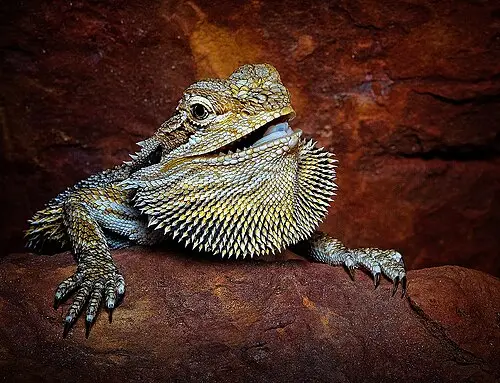
 📸 Photo
Photo: Toni Segers · CC BY-SA 4.0 · Wikimedia Commons Source
Central Bearded Dragon
Pogona vitticeps (Central Bearded Dragon · フトアゴヒゲトカゲ)
💡 Everyday Comparisons for Size, Mass & Speed
- 💡 Because of its manageable size and gentle temperament, it enjoys great popularity as a pet reptile (positive impacts on humans in ADW).
- 💡 A maximum length of 24 inches (about 61 cm) including the tail is the length of two 30 cm rulers placed end to end (Comparison).
Reference standards: coach bus ~12 m, mid-size car ~4.9 m, compact car ~1 t, basketball hoop 3.05 m, credit card 8.56 cm.
📖 1. Overview
The Central Bearded Dragon is a semi-arboreal lizard living in deserts and dry forests of inland Australia, named after the spiny-scaled 'beard' on its throat.
🦴 2. Anatomy & Morphology
It has a broad triangular head, a round torso, stout legs, and a robust tail. Its inflatable throat pouch bears spiny scales, and its body color varies with the soil color of its habitat from dull brown to tan with red or golden highlights.
🔍 3. Ecology & Behavior
Living where food is scarce, it is an opportunistic omnivore that eats plants, insects, and occasionally small rodents or lizards. Males puff out and blacken their beards while gaping to threaten rivals or court females, and females lay up to 24 eggs per clutch and up to 9 clutches a year.
🇰🇷 4. Connection to Korea
No direct record connecting this species to Korea has been found.
📚 Sources & References
- • IUCN Red List LC (2018) — https://www.iucnredlist.org/species/83494364/83494440
- • IUCN Red List category LC — latest assessment at iucnredlist.org
- • catalogueoflife.org — 4KV6Z
- • iucnredlist.org — 83494440
- • wikidata.org — Q792301
- • commons.wikimedia.org — File:Australian Bearded Dragon.jpg
- • animaldiversity.org — Pogona vitticeps
- • Silhouette: PhyloPic — Felix Vaux · CC0 1.0
Recorded dimensions are widely cited representative estimates from public literature and may vary by study or specimen.