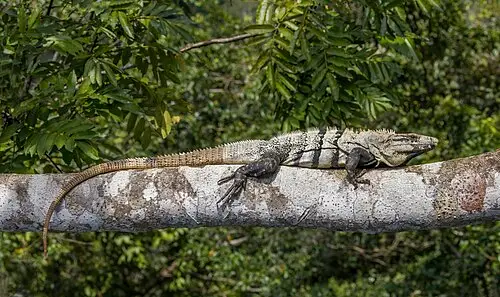
 📸 Photo
Photo: Charles J. Sharp · CC BY-SA 4.0 · Wikimedia Commons Source
Common Spiny-tailed Iguana
Ctenosaura similis (Common Spiny-tailed Iguana · ツナギトゲオイグアナ)
💡 Everyday Comparisons for Size, Mass & Speed
- 💡 Its meat is a popular food among rural communities in Central America, where some also believe eating it imparts strength (benefit to humans noted by ADW).
- 💡 Its average weight of 1 kg equals a standard bag of sugar (1 kg) (Comparison).
- 💡 A trunk length of 18 inches (about 46 cm) equals one and a half 30 cm rulers (Comparison).
Reference standards: coach bus ~12 m, mid-size car ~4.9 m, compact car ~1 t, basketball hoop 3.05 m, credit card 8.56 cm.
Site-computed relative index from recorded values; not a formal scientific metric.
📖 1. Overview
The Common Spiny-tailed Iguana is a large, sturdy lizard living in colonies around stone walls, rocky slopes, and forest borders in dry, open terrain.
🦴 2. Anatomy & Morphology
Adult males have a body about 18 inches (46 cm) long with a similarly long tail. Predominantly black, often with black bands on the back, males develop a prominent dorsal crest and a small dewlap.
🔍 3. Ecology & Behavior
Generally herbivorous, feeding especially on legume fruits, it also eats rodents, bats, frogs, small birds, and insects. Juveniles eat insects before shifting to an herbivorous diet as they grow; colonies have a strict dominance hierarchy, and these iguanas can run on their two hind legs.
🇰🇷 4. Connection to Korea
No direct record connecting this species to Korea has been found.
📚 Sources & References
- • IUCN Red List LC (2015) — https://www.iucnredlist.org/species/174480/73611567
- • IUCN Red List category LC — latest assessment at iucnredlist.org
- • catalogueoflife.org — 3276T
- • iucnredlist.org — 73611567
- • wikidata.org — Q1132759
- • commons.wikimedia.org — File:Black iguana (Ctenosaura similis) Cayo.jpg
- • animaldiversity.org — Ctenosaura similis
- • Silhouette: PhyloPic — Jack Mayer Wood · CC0 1.0 (Related taxon silhouette — Iguana iguana)
Recorded dimensions are widely cited representative estimates from public literature and may vary by study or specimen.