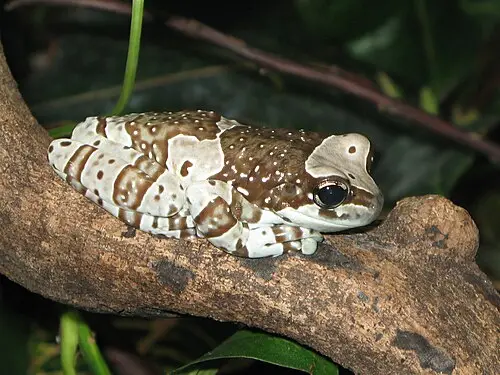
 📸 Photo
Photo: Crusier · CC BY 3.0 · Wikimedia Commons Source
Amazon Milk Frog
Trachycephalus resinifictrix (Amazon Milk Frog · ジュウジメドクアマガエル)
💡 Everyday Comparisons for Size, Mass & Speed
- 💡 The maximum snout-to-vent length of 6.4 cm among studied individuals is similar to 2.4 Korean 500-won coins (26.5 mm in diameter) lined up side by side (Comparison).
- 💡 Traded in the pet market under the name 'Amazon Milk Frog' (PMC paper), the Smithsonian's National Zoo introduced that it exhibits this frog in its Amazonia exhibit and feeds it crickets (2017).
Reference standards: coach bus ~12 m, mid-size car ~4.9 m, compact car ~1 t, basketball hoop 3.05 m, credit card 8.56 cm.
📖 1. Overview
The Amazon Milk Frog is a treefrog living in the trees of South American rainforests. It got the name 'milk' frog because it secretes a white, sticky substance from its skin when threatened.
🦴 2. Anatomy & Morphology
Special adhesive pads on its toes allow it to climb plants well and can support up to 14 times its body weight. Captive individuals used in research had a snout-to-vent length of 5.1–6.4 cm, weighed 7–19 g, and had beige and brown stripes on a bluish body.
🔍 3. Ecology & Behavior
In the wild it feeds on insects and small invertebrates and lives strictly in the high canopy of primary rainforests. Its landing motion, in which it leaps onto thin branches and grips them with its toe pads, has been studied.
🇰🇷 4. Connection to Korea
No direct record connecting this species to Korea has been found.
📚 Sources & References
- • IUCN Red List LC (2023) — https://www.iucnredlist.org/species/79680060/61405034
- • IUCN Red List category LC — latest assessment at iucnredlist.org
- • catalogueoflife.org — 57PW6
- • iucnredlist.org — 61405034
- • wikidata.org — Q672277
- • commons.wikimedia.org — File:Phrynohyas resinifictrix Warsaw Zoo 02.jpg
- • pmc.ncbi.nlm.nih.gov — PMC4819504
- • nationalzoo.si.edu — fun-facts-about-amazon-milk-frogs
- • bok.or.kr — contents.do
- • Silhouette: PhyloPic — Lauren McLean · CC BY 4.0
Recorded dimensions are widely cited representative estimates from public literature and may vary by study or specimen.