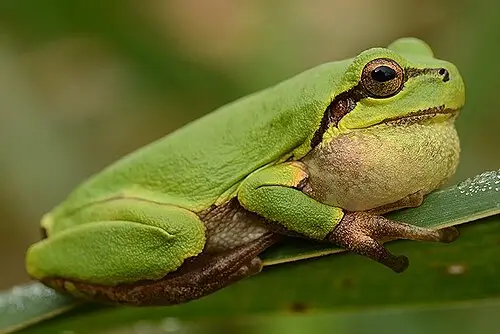
 📸 Photo
Photo: Kim, Hyun-tae · CC BY 4.0 · Wikimedia Commons Source
Suweon Treefrog
Hyla suweonensis (Suweon Treefrog · Suweon Treefrog)
Not Evaluated (NE) on the IUCN Red List yet.
🇰🇷 Class I endangered wildlife (Korea)
💡 Everyday Comparisons for Size, Mass & Speed
- 💡 Its body length of 4 cm is about 1.5 times the diameter of a Korean 500-won coin (about 2.65 cm) (Comparison).
- 💡 Because no breeding sites other than rice paddies are known, irrigation practices and pesticide use in paddies directly affect its population size.
- 💡 In April 2026, the Ministry of Climate, Energy and Environment selected and introduced the Suweon Treefrog as the 'Endangered Wildlife of the Month.'
Reference standards: coach bus ~12 m, mid-size car ~4.9 m, compact car ~1 t, basketball hoop 3.05 m, credit card 8.56 cm.
📖 1. Overview
The Suweon Treefrog is a small treefrog endemic to Korea and the first amphibian in the country listed as Class I endangered wildlife (Korea). Both Hyla and Dryophytes are used as its genus name.
🦴 2. Anatomy & Morphology
Compared with the common treefrog, it has a more pointed head, a smaller body, shorter hind legs, and less developed webbing between the toes. Its back is green or bluish green, its belly is white, and the male's vocal sac is usually yellow.
🔍 3. Ecology & Behavior
It preys on insects such as flies, bees, butterflies, and beetles, and lays eggs mainly in rice paddies and agricultural ditches from May to July. It begins calling earlier in the afternoon and in a lower-pitched voice than the common treefrog.
🇰🇷 4. Connection to Korea
A Korean endemic designated as Class I endangered wildlife (Korea), it lives in Wonju in Gangwon-do, Gyeonggi-do, Seoul, Chungcheongnam-do, and parts of Jeollabuk-do and Chungcheongbuk-do. Habitat destruction from pesticide use has strongly contributed to its decline, and in April 2026 the Ministry of Climate, Energy and Environment introduced it as the 'Endangered Wildlife of the Month.'
📚 Sources & References
- • 멸종위기 야생생물 Ⅰ급 — 국가생물종목록(국립생물자원관) ktsn 120000474038 — https://species.nibr.go.kr/home/mainHome.do?cont_link=009&subMenu=009002&contCd=009002&ktsn=120000474038
- • IUCN Red List: not evaluated (NE) — cross-checked with the Wikidata conservation-status entry
- • Korean protection status: Class I endangered wildlife (Korea)
- • catalogueoflife.org — 37VNQ
- • 국가생물종목록(국립생물자원관) ktsn 120000474038 — https://species.nibr.go.kr/home/mainHome.do?cont_link=009&subMenu=009002&contCd=009002&ktsn=120000474038
- • wikidata.org — Q3060896
- • commons.wikimedia.org — File:Hyla suweonensis.jpg
- • nie.re.kr — view.do
- • species.nibr.go.kr — mainHome.do
- • korea.kr — pressReleaseView.do
- • pmc.ncbi.nlm.nih.gov — PMC5631092
- • Silhouette: PhyloPic — Luca Leicht · CC BY 4.0 (Congeneric silhouette — Hyla arborea)
Recorded dimensions are widely cited representative estimates from public literature and may vary by study or specimen.