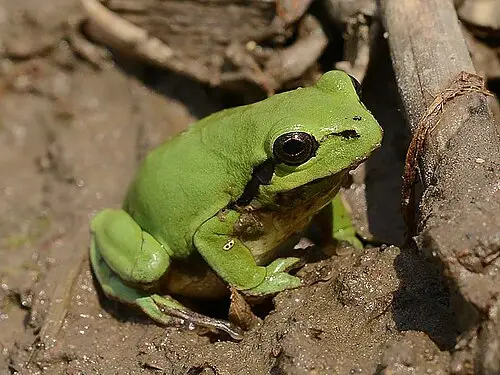
 📸 Photo
Photo: Kim, Hyun-tae · CC BY 4.0 · Wikimedia Commons Source
Yellow-bellied Treefrog
Dryophytes flaviventris (Yellow-bellied Treefrog · Yellow-bellied Treefrog)
💡 Everyday Comparisons for Size, Mass & Speed
- 💡 Its maximum body length of 40 mm is about 1.5 times the diameter of a Korean 500-won coin (26.5 mm in diameter) (Comparison).
- 💡 Known only from rice-paddy wetlands in the Geum River basin such as Iksan, Buyeo, and Nonsan, it is an endangered frog that depends on paddy wetlands for survival (National List of Species of Korea).
Reference standards: coach bus ~12 m, mid-size car ~4.9 m, compact car ~1 t, basketball hoop 3.05 m, credit card 8.56 cm.
📖 1. Overview
The Yellow-bellied Treefrog is an endemic species found only in Korea, restricted to rice-paddy wetlands in the Geum River basin. The IUCN assesses it as Endangered (EN, 2023).
🦴 2. Anatomy & Morphology
Its body length is 30–40 mm. During the breeding season its back is bright green without spots, turning dark gray or brown outside the breeding season, while the male's throat becomes yellow when breeding. Before developing legs, tadpoles reach up to 3 cm in length and have a pointed tail with transparent fins.
🔍 3. Ecology & Behavior
It lives in rice paddies and wetlands, and males develop a yellow throat during the breeding season. It is distinguished from the similar Suweon Treefrog by having a slightly longer body and legs and more reduced webbing on the hind feet.
🇰🇷 4. Connection to Korea
An endemic species of Korea, its distribution is restricted to the Geum River basin, including Iksan, Buyeo, and Nonsan (National List of Species of Korea).
📚 Sources & References
- • IUCN Red List EN (2023) — https://www.iucnredlist.org/species/184673273/188099200
- • IUCN Red List category EN — latest assessment at iucnredlist.org
- • catalogueoflife.org — NPGN2
- • iucnredlist.org — 188099200
- • 국가생물종목록(국립생물자원관) ktsn 120000474039 — https://species.nibr.go.kr/home/mainHome.do?cont_link=009&subMenu=009002&contCd=009002&ktsn=120000474039
- • wikidata.org — Q97304209
- • commons.wikimedia.org — File:Hyla flaviventris.jpg
- • species.nibr.go.kr — mainHome.do
- • bok.or.kr — contents.do
- • Silhouette: PhyloPic — author not recorded · CC0 1.0 (Related taxon silhouette — Litoria infrafrenata)
Recorded dimensions are widely cited representative estimates from public literature and may vary by study or specimen.