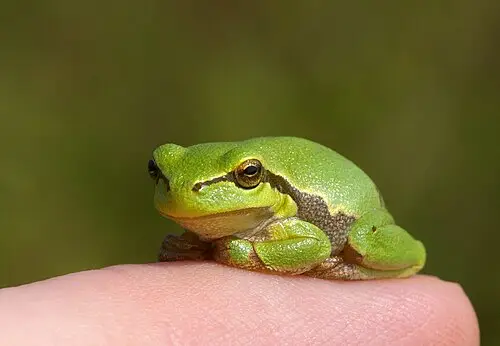
 📸 Photo
Photo: Christian Fischer · CC BY-SA 3.0 · Wikimedia Commons Source
European Treefrog
Hyla arborea (European Treefrog · ヨーロッパアマガエル)
💡 Everyday Comparisons for Size, Mass & Speed
- 💡 Its body length of about 4 cm is roughly 1.5 times the diameter of a Korean 500-won coin (26.5 mm in diameter) (Comparison).
- 💡 Thanks to the adhesive pads on its fingers and toes, it naps up in bushes or trees by day and choruses loudly at night, with large populations heard over 1 km away (Swiss KARCH).
Reference standards: coach bus ~12 m, mid-size car ~4.9 m, compact car ~1 t, basketball hoop 3.05 m, credit card 8.56 cm.
📖 1. Overview
The European Treefrog is a bright green treefrog living in Europe and is the smallest native frog in Switzerland, where it is treated as a Vulnerable (VU) species.
🦴 2. Anatomy & Morphology
Its upper body is vivid green and smooth, with a dark stripe running along the side and a whitish belly. Round suction-cup pads at the tips of its fingers and toes allow it to climb bushes and trees well, and males have a large vocal sac on the throat.
🔍 3. Ecology & Behavior
It hunts insects, spiders, and snails at night, and from April to early July males gather at the water's edge to chorus all night, with large groups audible more than 1 km away. Females attach 500–1,000 eggs to aquatic plants, and tadpoles hatch in 4–8 days.
🇰🇷 4. Connection to Korea
No direct record connecting this species to Korea has been found.
📚 Sources & References
- • IUCN Red List LC (2024) — https://www.iucnredlist.org/species/82496838/228182338
- • IUCN Red List category LC — latest assessment at iucnredlist.org
- • catalogueoflife.org — 3NCKV
- • iucnredlist.org — 228182338
- • wikidata.org — Q2142057
- • commons.wikimedia.org — File:Hyla arborea, juv 2.jpg
- • karch.ch — europaischer-laubfrosch-und-ital.html
- • bok.or.kr — contents.do
- • Silhouette: PhyloPic — Luca Leicht · CC BY 4.0
Recorded dimensions are widely cited representative estimates from public literature and may vary by study or specimen.