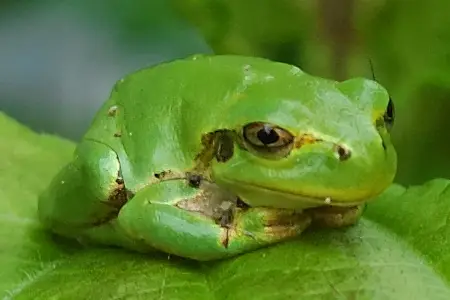
 📸 Photo
Photo: Kropsoq · CC BY-SA 3.0 · Wikimedia Commons Source
Japanese Treefrog
Hyla japonica (Japanese Treefrog · ニホンアマガエル)
💡 Everyday Comparisons for Size, Mass & Speed
- 💡 A maximum body length of 45 mm is slightly shorter than the length of two Korean 100-won coins (diameter 24 mm each) placed side by side (48 mm) (Comparison).
- 💡 Because rice paddies serve as both breeding and hunting grounds for the Japanese treefrog, it is frequently encountered in paddies during the rice-planting season (Seoul Grand Park; Ministry of Agriculture, Forestry and Fisheries of Japan). It catches and eats insects and spiders in rice paddies.
Reference standards: coach bus ~12 m, mid-size car ~4.9 m, compact car ~1 t, basketball hoop 3.05 m, credit card 8.56 cm.
📖 1. Overview
The Japanese treefrog is a small frog living in East Asia and Russia that breeds in rice paddies and changes its body color according to its surroundings.
🦴 2. Anatomy & Morphology
It is small, with a body length of 20–45 mm, and its skin is covered with smooth mucus. Because this mucus is toxic, one should wash one's hands after touching it, and its body color varies widely depending on the surrounding environment.
🔍 3. Ecology & Behavior
It rests in rock crevices or underground during the day and becomes active from early evening to hunt insects and spiders. In Korea, it breeds mainly in rice paddies when rice planting begins.
🇰🇷 4. Connection to Korea
In Korea, it breeds mainly in rice paddies when rice planting starts, and can be seen in forests, farmland, streams, valleys, and wetlands (Seoul Grand Park animal information).
📚 Sources & References
- • IUCN Red List LC (2023) — https://www.iucnredlist.org/species/55519/63863120
- • IUCN Red List category LC — latest assessment at iucnredlist.org
- • catalogueoflife.org — 37VNM
- • iucnredlist.org — 63863120
- • wikidata.org — Q733704
- • commons.wikimedia.org — File:Hylidae 001.jpg
- • maff.go.jp — spe2 02.html
- • grandpark.seoul.go.kr — S001002002003.do
- • bok.or.kr — contents.do
- • Silhouette: PhyloPic — Luca Leicht · CC BY 4.0 (Congeneric silhouette — Hyla arborea)
Recorded dimensions are widely cited representative estimates from public literature and may vary by study or specimen.