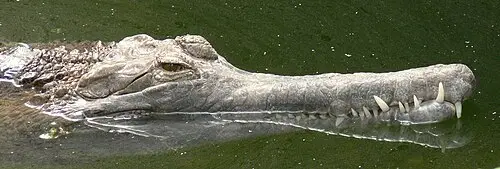
 📸 Photo
Photo: User:Haplochromis · CC BY-SA 3.0 · Wikimedia Commons Source
False Gharial
Tomistoma schlegelii (False Gharial · マレーガビアル)
💡 Everyday Comparisons for Size, Mass & Speed
- 💡 A maximum length of 5 m is slightly longer than a passenger car (about 4.5 m), and a maximum weight of 210 kg is ten and a half 20 kg bags of rice (Comparison).
- 💡 It was once hunted for its skin, though its hide is no longer of high commercial value, and in some areas its eggs are collected for traditional medicine (positive impacts on humans in ADW).
Reference standards: coach bus ~12 m, mid-size car ~4.9 m, compact car ~1 t, basketball hoop 3.05 m, credit card 8.56 cm.
Site-computed relative index from recorded values; not a formal scientific metric.
📖 1. Overview
The False Gharial is a large crocodilian living in lowland swamp forests and peat swamps of Southeast Asia, with a long gharial-like snout as its name suggests. Its IUCN assessment is Endangered (EN) as of 2023.
🦴 2. Anatomy & Morphology
Its long, slender snout holds 76–84 sharp teeth, and it has a streamlined body, a muscular tail, eyes and nostrils on top of the head, and a palatal valve that blocks the throat underwater. Its body is dark brown with black bands on the tail and body.
🔍 3. Ecology & Behavior
An opportunistic carnivore, it grabs monkeys from watersides and drowns them, and also eats wild pigs, deer, otters, fish, birds, turtles, snakes, and monitor lizards. It spends most of its time submerged in shallow water with only its eyes and nostrils showing, and can stay underwater for an hour or two to avoid threats.
🇰🇷 4. Connection to Korea
No direct record connecting this species to Korea has been found.
📚 Sources & References
- • IUCN Red List EN (2023) — https://www.iucnredlist.org/species/21981/214287051
- • IUCN Red List category EN — latest assessment at iucnredlist.org
- • catalogueoflife.org — 57D4X
- • iucnredlist.org — 214287051
- • wikidata.org — Q242464
- • commons.wikimedia.org — File:Tomistoma schlegelii.jpg
- • animaldiversity.org — Tomistoma schlegelii
- • Silhouette: PhyloPic — Armin Reindl · CC BY 4.0 (Related taxon silhouette — Sutekhsuchus dowsoni)
Recorded dimensions are widely cited representative estimates from public literature and may vary by study or specimen.