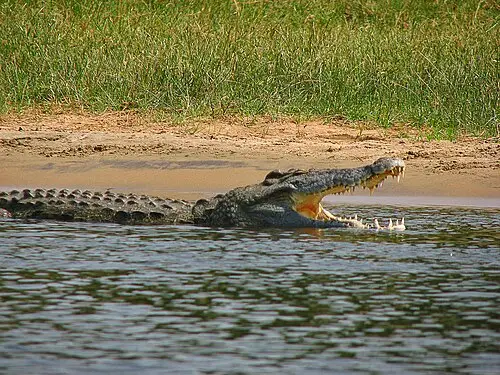
 📸 Photo
Photo: Tim Muttoo · CC BY-SA 2.0 · Wikimedia Commons Source
Nile Crocodile
Crocodylus niloticus (Nile Crocodile · ナイルワニ)
💡 Everyday Comparisons for Size, Mass & Speed
- 💡 Its maximum length of 5 m is slightly longer than a passenger car (about 4.5 m) (Comparison).
- 💡 In ancient Egypt, crocodiles were worshipped as the god Sobek, and crocodile mummies have been found in tombs (San Diego Zoo Wildlife Alliance).
- 💡 In some places Nile Crocodiles are raised on farms for their leather (same source).
Reference standards: coach bus ~12 m, mid-size car ~4.9 m, compact car ~1 t, basketball hoop 3.05 m, credit card 8.56 cm.
📖 1. Overview
The Nile Crocodile is the largest crocodile in Africa, widely distributed in lakes, rivers, and coastal swamps across sub-Saharan Africa. Its IUCN status is Least Concern (LC) as of 2019.
🦴 2. Anatomy & Morphology
Its narrow snout reduces drag underwater, and salt-excreting glands on its tongue allow it to adapt to saline waters. Males are larger than females.
🔍 3. Ecology & Behavior
Juveniles eat insects, while adults take large animals such as impalas, bushbucks, buffaloes, and young hippos. Active mainly at night and basking or cooling in the water by day, females dig holes in sand during the dry season to lay about 55–60 eggs and guard them.
🇰🇷 4. Connection to Korea
No direct record connecting this species to Korea has been found.
📚 Sources & References
- • IUCN Red List LC (2019) — https://www.iucnredlist.org/species/45433088/3010181
- • IUCN Red List category LC — latest assessment at iucnredlist.org
- • catalogueoflife.org — ZKNK
- • iucnredlist.org — 3010181
- • wikidata.org — Q168745
- • commons.wikimedia.org — File:Crocodylus niloticus6.jpg
- • ielc.libguides.com — nile crocodile
- • Silhouette: PhyloPic — Photograph by Caleb M. Gordon of YPM.HERR.008198, a fluid-preserved C. niloticus juvenile specimen at the Yale Peabody Museum. · CC BY 4.0
Recorded dimensions are widely cited representative estimates from public literature and may vary by study or specimen.