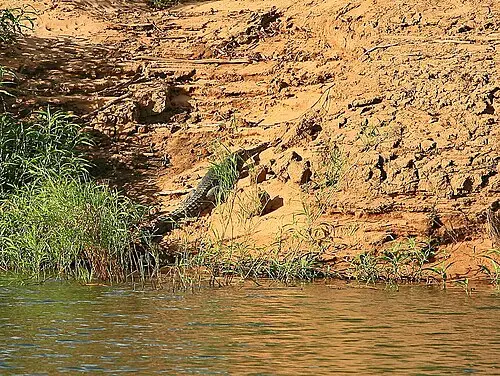
 📸 Photo
Photo: W. Bulach · CC BY-SA 4.0 · Wikimedia Commons Source
Freshwater Crocodile
Crocodylus johnstoni (Freshwater Crocodile · オーストラリアワニ)
💡 Everyday Comparisons for Size, Mass & Speed
- 💡 Its maximum length of 3 m is about 2/3 the length of a passenger car (about 4.5 m) (Comparison).
- 💡 Because the tail makes up nearly half its total length, a 3 m individual has a tail around 1.5 m long, about two adult strides (Comparison).
- 💡 Natural predators of adults are mainly other crocodiles and toxic cane toads (Australian Museum).
Reference standards: coach bus ~12 m, mid-size car ~4.9 m, compact car ~1 t, basketball hoop 3.05 m, credit card 8.56 cm.
📖 1. Overview
The Freshwater Crocodile is a shy, quiet crocodile living in rivers, streams, and waterholes of northern Australia, much smaller and more slender than the Saltwater Crocodile. Its IUCN status is Least Concern (LC) as of 2017.
🦴 2. Anatomy & Morphology
It has a narrow snout and small build, grey to tan coloration with dark blotches on the sides and back, nostrils and eyes set high on the head, a tail nearly half the total body length, and hind legs much longer than the front legs.
🔍 3. Ecology & Behavior
Insects are its most common prey followed by fish, and it also eats crustaceans, frogs, turtles, snakes, birds, and mammals. It waits motionless in shallow water to snatch small prey sideways, and in the dry season it may estivate in creek-bank burrows.
🇰🇷 4. Connection to Korea
No direct record connecting this species to Korea has been found.
📚 Sources & References
- • IUCN Red List LC (2017) — https://www.iucnredlist.org/species/46589/3010118
- • IUCN Red List category LC — latest assessment at iucnredlist.org
- • catalogueoflife.org — C6Q4M
- • iucnredlist.org — 3010118
- • wikidata.org — Q319535
- • commons.wikimedia.org — File:.00 1042 Freshwater crocodile.jpg
- • australian.museum — freshwater-crocodile
- • Silhouette: PhyloPic — Becky Barnes · CC0 1.0 (Congeneric silhouette — Crocodylus)
Recorded dimensions are widely cited representative estimates from public literature and may vary by study or specimen.