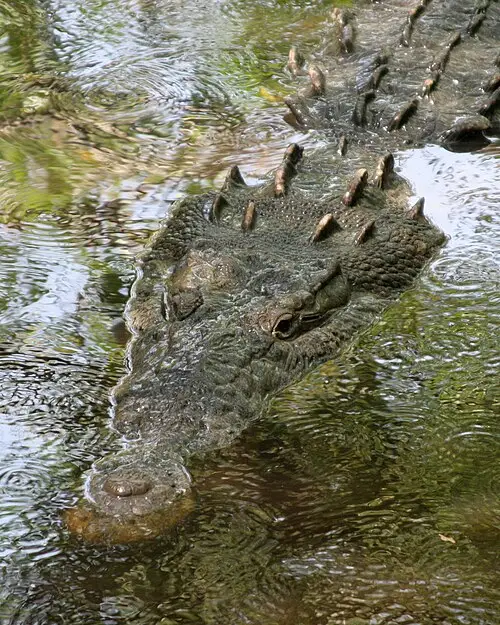
 📸 Photo
Photo: Tomás Castelazo · CC BY-SA 2.5 · Wikimedia Commons Source
American Crocodile
Crocodylus acutus (American Crocodile · アメリカワニ)
💡 Everyday Comparisons for Size, Mass & Speed
- 💡 Its average length of 3.5 m is about 3/4 the length of a passenger car (about 4.5 m), and 450 kg equals twenty-two and a half 20 kg bags of rice (Comparison).
- 💡 American Crocodiles have also been found in brackish canals beside a power plant in Florida, USA, living close to human-built facilities (habitat description in ADW).
- 💡 In some areas it is hunted for meat and hide (benefit to humans noted by ADW).
Reference standards: coach bus ~12 m, mid-size car ~4.9 m, compact car ~1 t, basketball hoop 3.05 m, credit card 8.56 cm.
Site-computed relative index from recorded values; not a formal scientific metric.
📖 1. Overview
The American Crocodile is a medium-sized crocodile inhabiting a wide range of aquatic habitats from freshwater to brackish water and hypersaline lakes. Its IUCN status is Vulnerable (VU) as of 2022.
🦴 2. Anatomy & Morphology
Its narrow head and long snout distinguish it from alligators, and its sharp, jagged teeth interlock. It has a transparent eyelid to see underwater and an iris structure that gives it good night vision.
🔍 3. Ecology & Behavior
A carnivore that mainly eats fish, frogs, and turtles and occasionally birds or small mammals, it swallows prey whole and ingests small stones to aid digestion. Mostly solitary, it remains inactive in mud during the dry season and lays 30–60 eggs at a time.
🇰🇷 4. Connection to Korea
No direct record connecting this species to Korea has been found.
📚 Sources & References
- • IUCN Red List VU (2022) — https://www.iucnredlist.org/species/5659/212805700
- • IUCN Red List category VU — latest assessment at iucnredlist.org
- • catalogueoflife.org — ZKNB
- • iucnredlist.org — 212805700
- • wikidata.org — Q207836
- • commons.wikimedia.org — File:Crocodylus acutus mexico 01.jpg
- • animaldiversity.org — Crocodylus acutus
- • Silhouette: PhyloPic — Beth Reinke · CC0 1.0
Recorded dimensions are widely cited representative estimates from public literature and may vary by study or specimen.