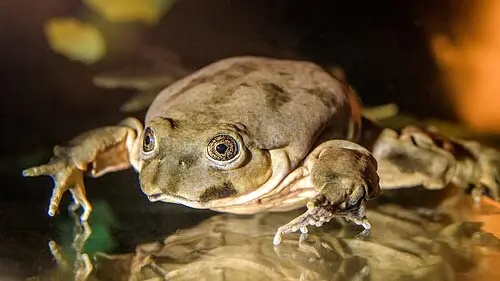
 📸 Photo
Photo: Petr Hamerník · CC BY-SA 4.0 · Wikimedia Commons Source
Titicaca Water Frog
Telmatobius culeus (Titicaca Water Frog · チチカカミズガエル)
💡 Everyday Comparisons for Size, Mass & Speed
- 💡 The elevation of the lake it inhabits, 3,812 m, is about twice the height of Hallasan in Korea (1,947 m) (Comparison).
- 💡 Its body length of 13.8 cm is about 1.6 times the long side of a credit card (85.6 mm) (Comparison).
Reference standards: coach bus ~12 m, mid-size car ~4.9 m, compact car ~1 t, basketball hoop 3.05 m, credit card 8.56 cm.
📖 1. Overview
The Titicaca Water Frog is a fully aquatic frog found only in Lake Titicaca at an elevation of 3,812 m. It is listed as Endangered (EN, 2020 assessment) on the IUCN Red List.
🦴 2. Anatomy & Morphology
Measuring about 7.4–13.8 cm in body length, it has loose folds of skin hanging from its sides, back, and hind legs. Because these folds expand the surface area for breathing through the skin, its lungs are small and flattened and hardly need to be used.
🔍 3. Ecology & Behavior
Solitary and nocturnal, it feeds mostly on amphipods and snails and also eats tadpoles and fish (Titicaca orestias). When dissolved oxygen in the water drops, it extends its limbs on the lake bottom to maximize skin surface area and does 'push-ups' by bobbing its body up and down about once every 6 seconds.
🇰🇷 4. Connection to Korea
No direct record connecting this species to Korea has been found.
📚 Sources & References
- • IUCN Red List EN (2020) — https://www.iucnredlist.org/species/57334/178948447
- • IUCN Red List category EN — latest assessment at iucnredlist.org
- • catalogueoflife.org — 7BPSR
- • iucnredlist.org — 178948447
- • wikidata.org — Q1628083
- • commons.wikimedia.org — File:Vodnice posvátná zoo praha 1.jpg
- • animaldiversity.org — Telmatobius culeus
- • Silhouette: PhyloPic — Jose Carlos Arenas-Monroy · CC0 1.0
Recorded dimensions are widely cited representative estimates from public literature and may vary by study or specimen.