 📸 Photo
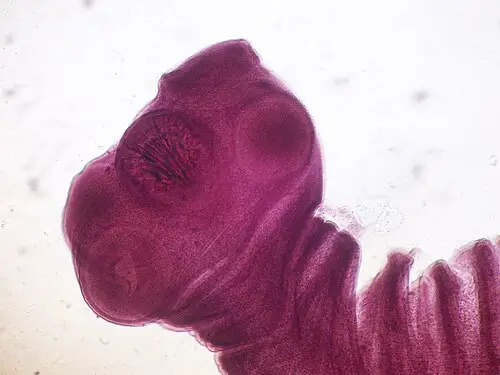
Photo: Roberto J. Galindo · CC BY-SA 3.0 · Wikimedia Commons Source
Pork tapeworm
Taenia solium (Pork tapeworm · 有鉤条虫)
Not Evaluated (NE) on the IUCN Red List yet.
💡 Everyday Comparisons for Size, Mass & Speed
- 💡 Its maximum body length of 10 m is similar to the length of a city bus (about 10–12 m) (Comparison).
- 💡 Humans become infected when they eat pork infected with larvae. It is an unusual species in which humans serve as the definitive host and can also become an intermediate host (ADW).
Reference standards: coach bus ~12 m, mid-size car ~4.9 m, compact car ~1 t, basketball hoop 3.05 m, credit card 8.56 cm.
📖 1. Overview
The pork tapeworm is a tapeworm living in the human small intestine and transmitted through pork. It has no digestive tract.
🦴 2. Anatomy & Morphology
Its head (scolex) has 4 suckers and hooks to attach to the intestine, and its body consists of many segments (proglottids), each containing both male and female reproductive organs. Lacking a digestive tract, it absorbs nutrients through its body surface and reaches 2–10 m in length.
🔍 3. Ecology & Behavior
When a person eats pork containing larvae (cysticerci), the worm develops into an adult inside the human body. Egg-filled segments pass out with feces, and if a person swallows the eggs, larvae can spread throughout the body.
🇰🇷 4. Connection to Korea
It is listed on the National List of Species of Korea under the name Yugujochung (Korean name).
📚 Sources & References
- • IUCN Red List: not evaluated (NE) — cross-checked with the Wikidata conservation-status entry
- • catalogueoflife.org — 8N695
- • 국가생물종목록(국립생물자원관) ktsn 120000041324 — https://species.nibr.go.kr/home/mainHome.do?cont_link=009&subMenu=009002&contCd=009002&ktsn=120000041324
- • wikidata.org — Q565708
- • commons.wikimedia.org — File:Taenia solium scolex.JPG
- • animaldiversity.org — Taenia solium
- • Silhouette: PhyloPic — Centers for Disease Control and Prevention · Public Domain Mark 1.0 (Congeneric silhouette — Taenia saginata)
Recorded dimensions are widely cited representative estimates from public literature and may vary by study or specimen.