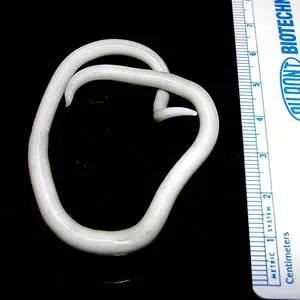
 📸 Photo
Photo: Public domain · Public domain · Wikimedia Commons Source
Giant roundworm
Ascaris lumbricoides (Giant roundworm · 回虫)
Not Evaluated (NE) on the IUCN Red List yet.
💡 Everyday Comparisons for Size, Mass & Speed
- 💡 A female's average length of 30 cm is almost equal to the long side of an A4 sheet of paper (29.7 cm) (Comparison).
- 💡 Fertilized eggs can survive for up to 10 years in warm, moist soil (ADW).
Reference standards: coach bus ~12 m, mid-size car ~4.9 m, compact car ~1 t, basketball hoop 3.05 m, credit card 8.56 cm.
📖 1. Overview
The giant roundworm is the largest nematode (roundworm) parasitizing the human small intestine. It is distributed worldwide and also occurs throughout Korea.
🦴 2. Anatomy & Morphology
Females average 30 cm (20–49 cm) in length and 3–6 mm in diameter, while males are smaller at 15–30 cm. The body is an elongated cylinder tapering at both ends and cream-colored, and the male's tail curves toward the underside.
🔍 3. Ecology & Behavior
It feeds on liquid contents flowing through the small intestine. Fertilized eggs take about 3 weeks in soil to become infective and can survive up to 10 years in warm, moist soil. Larvae travel through the liver, heart, and lungs before returning to the intestine.
🇰🇷 4. Connection to Korea
It is listed in the National List of Species of Korea and is distributed nationwide.
📚 Sources & References
- • IUCN Red List: not evaluated (NE) — cross-checked with the Wikidata conservation-status entry
- • catalogueoflife.org — 99GCP
- • 국가생물종목록(국립생물자원관) ktsn 120000040709 — https://species.nibr.go.kr/home/mainHome.do?cont_link=009&subMenu=009002&contCd=009002&ktsn=120000040709
- • wikidata.org — Q468771
- • commons.wikimedia.org — File:Ascaris lumbricoides.jpeg
- • animaldiversity.org — Ascaris lumbricoides
- • species.nibr.go.kr — mainHome.do
Recorded dimensions are widely cited representative estimates from public literature and may vary by study or specimen.