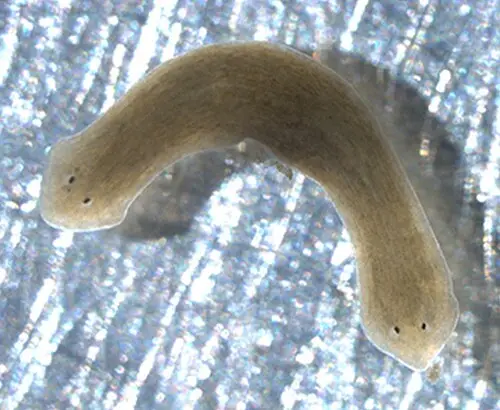
 📸 Photo
Photo: Taisaku Nogi, Dan Zhang, John D. Chan, Jonathan S. Marchant · CC BY 2.5 · Wikimedia Commons Source
Dugesia japonica
Dugesia japonica (Dugesia japonica · ナミウズムシ)
Not Evaluated (NE) on the IUCN Red List yet.
💡 Everyday Comparisons for Size, Mass & Speed
- 💡 Because of its ability to regenerate even after being cut into pieces, it is used as a model animal in biology classes and regeneration research (Frontiers in Genetics).
- 💡 A study showed that it can be raised in the laboratory for over 1 year on bloodworms instead of beef liver, offering an experimental method that reduces the use of vertebrates (PMC).
- 💡 A length of 1 cm is similar to two grains of rice (about 5 mm each) placed end to end (Comparison).
Reference standards: coach bus ~12 m, mid-size car ~4.9 m, compact car ~1 t, basketball hoop 3.05 m, credit card 8.56 cm.
📖 1. Overview
Dugesia japonica is a flattened freshwater flatworm famous for its regenerative ability to rebuild an entire body from just a small body fragment.
🦴 2. Anatomy & Morphology
Its body length is around 1 cm in laboratory specimens. Even when cut into pieces, it regenerates its head and all parts of its body.
🔍 3. Ecology & Behavior
It naturally feeds on insect larvae such as bloodworms (chironomid larvae), and a study has maintained it in the laboratory for over 1 year on bloodworms alone. In laboratories, it is commonly fed ground beef or chicken liver.
🇰🇷 4. Connection to Korea
It is listed as 'Peullanaria' (Korean name) in the National List of Species of Korea.
📚 Sources & References
- • IUCN Red List: not evaluated (NE) — cross-checked with the Wikidata conservation-status entry
- • catalogueoflife.org — 6DPB9
- • 국가생물종목록(국립생물자원관) ktsn 120000041351 — https://species.nibr.go.kr/home/mainHome.do?cont_link=009&subMenu=009002&contCd=009002&ktsn=120000041351
- • wikidata.org — Q1865696
- • commons.wikimedia.org — File:Two headed Dugesia japonica.jpg
- • frontiersin.org — full
- • pmc.ncbi.nlm.nih.gov — PMC12730930
- • Silhouette: PhyloPic — Markus A. Grohme · CC0 1.0
Recorded dimensions are widely cited representative estimates from public literature and may vary by study or specimen.