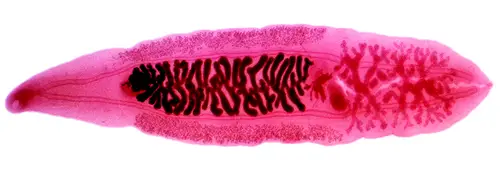
 📸 Photo
Photo: Banchob Sripa, Sasithorn Kaewkes, Paiboon Sithithaworn, Eimorn Mairiang, Thewarach Laha, Michael Smout, Chawalit Pairojkul, Vajaraphongsa Bhudhisawasdi, Smarn T · CC BY 2.5 · Wikimedia Commons Source
Chinese liver fluke
Clonorchis sinensis (Chinese liver fluke · 肝吸虫)
Not Evaluated (NE) on the IUCN Red List yet.
💡 Everyday Comparisons for Size, Mass & Speed
- 💡 An adult length of 25 mm is almost equal to the diameter of a Korean 500-won coin (26.5 mm) (Comparison).
- 💡 Humans become infected through freshwater fish, and about 12 species of fish are known as the main transmitters to humans (ADW).
Reference standards: coach bus ~12 m, mid-size car ~4.9 m, compact car ~1 t, basketball hoop 3.05 m, credit card 8.56 cm.
📖 1. Overview
The Chinese liver fluke is a flatworm that parasitizes the liver and bile ducts of mammals such as humans, dogs, and cats. It is distributed in Korea, Japan, China, and Southeast Asia.
🦴 2. Anatomy & Morphology
Adults are very thin, flattened flukes 10–25 mm long, narrow in front and broad behind. They have an oral sucker and a ventral sucker, lack a circulatory system and body cavity, and may look yellow from absorbing bile.
🔍 3. Ecology & Behavior
It lives by feeding on bile. Eggs pass out in feces and go through a first intermediate host, the freshwater snail Parafossarulus manchouricus, and a second intermediate host, freshwater fish, before reaching final hosts such as humans, dogs, cats, and pigs. A single adult lays about 4,000 eggs per day for more than 6 months.
🇰🇷 4. Connection to Korea
It is listed in the National List of Species of Korea and is distributed nationwide.
📚 Sources & References
- • IUCN Red List: not evaluated (NE) — cross-checked with the Wikidata conservation-status entry
- • catalogueoflife.org — 7SCPX
- • 국가생물종목록(국립생물자원관) ktsn 120000041264 — https://species.nibr.go.kr/home/mainHome.do?cont_link=009&subMenu=009002&contCd=009002&ktsn=120000041264
- • wikidata.org — Q1074210
- • commons.wikimedia.org — File:Clonorchis sinensis 2.png
- • animaldiversity.org — Clonorchis sinensis
- • species.nibr.go.kr — mainHome.do
- • Silhouette: PhyloPic — Web Atlas of Medical Parasitology and the Korean Society for Parasitology · Public Domain Mark 1.0 (Related taxon silhouette — Opisthorchis felineus)
Recorded dimensions are widely cited representative estimates from public literature and may vary by study or specimen.