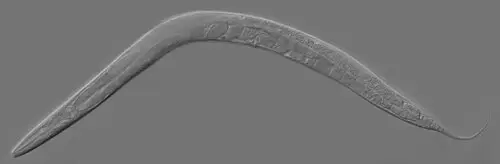
 📸 Photo
Photo: The original uploader was Kbradnam at English Wikipedia . ( Original text: Zeynep F. Altun, Editor of www.wormatlas.org ) · CC BY-SA 2.5 · Wikimedia Commons Source
C. elegans
Caenorhabditis elegans (C. elegans · カエノラブディティス・エレガンス)
Not Evaluated (NE) on the IUCN Red List yet.
💡 Everyday Comparisons for Size, Mass & Speed
- 💡 A body length of about 1 mm is about 1/5 the length of a grain of rice (about 5 mm) (Comparison).
- 💡 Because its transparent body makes it easy to study, it is bred in laboratories as a model organism for scientific research (ADW).
Reference standards: coach bus ~12 m, mid-size car ~4.9 m, compact car ~1 t, basketball hoop 3.05 m, credit card 8.56 cm.
📖 1. Overview
C. elegans is a tiny nematode about 1 mm long living in soil and rotting vegetation, famous as a laboratory model organism.
🦴 2. Anatomy & Morphology
Its body is a smooth cylinder tapering at both ends, lacking segments or appendages. Because its body is transparent and composed of exactly 959 cells, each individual cell can be observed under a microscope.
🔍 3. Ecology & Behavior
It moves along films of water in soil and feeds on bacteria. Most individuals are self-fertilizing hermaphrodites, while males make up 0.2% or less of natural populations. At 20–25 °C, it takes about 3 days from egg to adult, and its average lifespan is 2–3 weeks.
🇰🇷 4. Connection to Korea
No direct record connecting this species to Korea has been found.
📚 Sources & References
- • IUCN Red List: not evaluated (NE) — cross-checked with the Wikidata conservation-status entry
- • catalogueoflife.org — 87THG
- • wikidata.org — Q91703
- • commons.wikimedia.org — File:Adult Caenorhabditis elegans.jpg
- • animaldiversity.org — Caenorhabditis elegans
- • Silhouette: PhyloPic — Taylor Medwig-Kinney · CC0 1.0
Recorded dimensions are widely cited representative estimates from public literature and may vary by study or specimen.