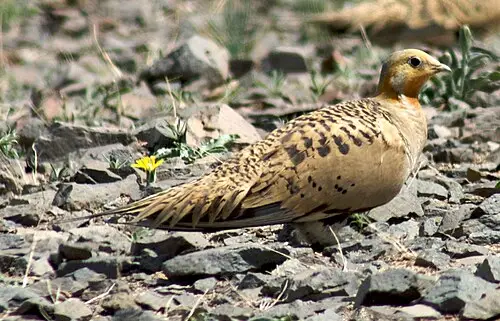
 📸 Photo
Photo: Tomju48 · CC BY-SA 3.0 · Wikimedia Commons Source
Pallas's Sandgrouse
Syrrhaptes paradoxus (Pallas's Sandgrouse · サケイ)
💡 Everyday Comparisons for Size, Mass & Speed
- 💡 In 1863, 1888, and 1908, hundreds to thousands flew to Britain, and in 1888–89 several pairs bred in northeastern Scotland and Yorkshire (British Trust for Ornithology).
- 💡 Its weight of about 265 g is similar to a medium-sized apple (about 250 g) (Comparison).
Reference standards: coach bus ~12 m, mid-size car ~4.9 m, compact car ~1 t, basketball hoop 3.05 m, credit card 8.56 cm.
Site-computed relative index from recorded values; not a formal scientific metric.
📖 1. Overview
Pallas's Sandgrouse is a bird that breeds in semi-deserts and steppes from Uzbekistan to northwestern China and occasionally irrupts westward in large flocks. Birds of the sandgrouse family have short, feathered legs.
🦴 2. Anatomy & Morphology
Sandgrouse have mottled brown plumage that camouflages them on dusty ground, along with a plump body and short legs covered in feathers.
🔍 3. Ecology & Behavior
Sandgrouse feed mainly on seeds and may fly more than 30 km in search of water. When caring for chicks, adults soak their belly feathers with water and carry it back to the nest.
🇰🇷 4. Connection to Korea
It is listed under the name 'Samak-kkwong' (Korean name) in the National List of Species of Korea.
📚 Sources & References
- • IUCN Red List LC (2024) — https://www.iucnredlist.org/species/22692980/263662143
- • IUCN Red List category LC — latest assessment at iucnredlist.org
- • doi.org — avilist.v2026
- • iucnredlist.org — 263662143
- • 국가생물종목록(국립생물자원관) ktsn 120000001818 — https://species.nibr.go.kr/home/mainHome.do?cont_link=009&subMenu=009002&contCd=009002&ktsn=120000001818
- • wikidata.org — Q128002
- • commons.wikimedia.org — File:Syrrhapte paradoxal (cropped).jpg
- • bto.org — pallass-sandgrouse
- • bto.org — pteroclididae-sandgrouse
- • Silhouette: PhyloPic — Andy Wilson · CC0 1.0
Recorded dimensions are widely cited representative estimates from public literature and may vary by study or specimen.