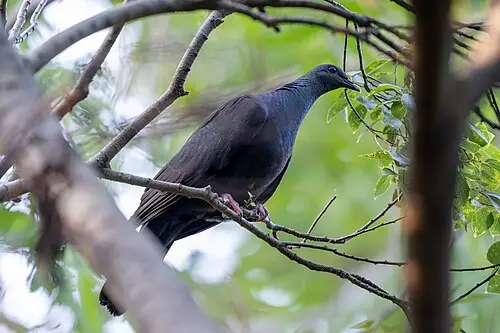
 📸 Photo
Photo: Wang.QG · CC BY 4.0 · Wikimedia Commons Source
Black Wood Pigeon
Columba janthina (Black Wood Pigeon · カラスバト)
🇰🇷 Class II endangered wildlife (Korea) · Natural Monument (Korea) «Black Wood Pigeon»
💡 Everyday Comparisons for Size, Mass & Speed
- 💡 On Ulleungdo, it is also called Geomeun-bidulgi ('black pigeon', Korean name) for its black color and Ppeokkum-sae (Korean name, after its call) (Korea Heritage Service).
- 💡 Its total length of about 40 cm is around half the length of a baseball bat (about 84 cm) (Comparison).
Reference standards: coach bus ~12 m, mid-size car ~4.9 m, compact car ~1 t, basketball hoop 3.05 m, credit card 8.56 cm.
📖 1. Overview
The black wood pigeon is a glossy black pigeon that is among the largest wild pigeons, living along coasts and islands of Korea, southern Japan, and China. In Korea, it is a rare resident bird living year-round on Ulleungdo and southern coastal islands.
🦴 2. Anatomy & Morphology
Its body is black overall with a purplish metallic sheen on the head and a green metallic sheen on the body. Its bill is dark grey and its legs are red.
🔍 3. Ecology & Behavior
It builds a shallow saucer-shaped nest in a tree cavity or on a rock and lays a single white egg, mainly in May–June (months 5–6). It hangs upside down from branches to eat camellia flowers and fruits.
🇰🇷 4. Connection to Korea
It is a Class II endangered wildlife (Korea) species and was designated a Natural Monument (Korea) on November 22, 1968 (1968-11-22). It breeds on islands such as Ulleungdo, Soheuksando, and Sasudo in Jeju.
📚 Sources & References
- • IUCN Red List LC (2023) — https://www.iucnredlist.org/species/22690206/180919189
- • 멸종위기 야생생물 Ⅱ급 · 천연기념물 «흑비둘기» — 국가생물종목록(국립생물자원관) ktsn 120000001823 — https://species.nibr.go.kr/home/mainHome.do?cont_link=009&subMenu=009002&contCd=009002&ktsn=120000001823
- • IUCN Red List category LC — latest assessment at iucnredlist.org
- • Korean protection status: Class II endangered wildlife (Korea) · Natural Monument (Korea) «Black Wood Pigeon»
- • doi.org — avilist.v2026
- • iucnredlist.org — 180919189
- • 국가생물종목록(국립생물자원관) ktsn 120000001823 — https://species.nibr.go.kr/home/mainHome.do?cont_link=009&subMenu=009002&contCd=009002&ktsn=120000001823
- • heritage.go.kr — culSelectDetail.do
- • wikidata.org — Q495139
- • encykorea.aks.ac.kr — E0065888
- • encykorea.aks.ac.kr — E0025113
- • Silhouette: PhyloPic — Ferran Sayol · CC0 1.0 (Congeneric silhouette — Columba)
Recorded dimensions are widely cited representative estimates from public literature and may vary by study or specimen.