 📸 Photo
Photo: xulescu_g · CC BY-SA 2.0 · Wikimedia Commons Source
Eurasian Collared Dove
Streptopelia decaocto (Eurasian Collared Dove · シラコバト)
💡 Everyday Comparisons for Size, Mass & Speed
- 💡 Its body length of 33 cm is about 3 cm longer than the long side of an A4 sheet of paper (29.7 cm) (Comparison).
- 💡 Because it also eats bread crumbs and food scraps discarded by people and nests on protruding building ledges, it lives close to human settlements.
Reference standards: coach bus ~12 m, mid-size car ~4.9 m, compact car ~1 t, basketball hoop 3.05 m, credit card 8.56 cm.
📖 1. Overview
The Eurasian Collared Dove is a dove that breeds widely across Eurasia from western Europe to East Asia, and in Korea it lives in places such as islands in the West Sea.
🦴 2. Anatomy & Morphology
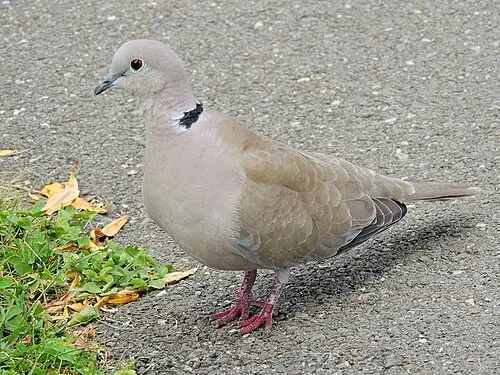
Its forehead and crown are pale grayish-brown with a rosy tinge, and its breast and belly are rosy gray. Its bill is dull black and its legs are red.
🔍 3. Ecology & Behavior
It favors plant seeds and fruits, but also eats discarded bread crumbs, food scraps, vegetables, berries, cherries, and some insects. It nests in pine, cedar, or bamboo trees or on protruding building ledges, laying 2 eggs between March and July.
🇰🇷 4. Connection to Korea
The National List of Species of Korea records it as inhabiting various parts of Korea, including Hongdo and islands in the West Sea.
📚 Sources & References
- • IUCN Red List LC (2019) — https://www.iucnredlist.org/species/22727811/154457750
- • IUCN Red List category LC — latest assessment at iucnredlist.org
- • doi.org — avilist.v2026
- • iucnredlist.org — 154457750
- • 국가생물종목록(국립생물자원관) ktsn 120000001826 — https://species.nibr.go.kr/home/mainHome.do?cont_link=009&subMenu=009002&contCd=009002&ktsn=120000001826
- • wikidata.org — Q54696
- • commons.wikimedia.org — File:Streptopelia decaocto, Hărman, România (34881606270).jp
- • species.nibr.go.kr — mainHome.do
- • Silhouette: PhyloPic — Andy Wilson · CC0 1.0
Recorded dimensions are widely cited representative estimates from public literature and may vary by study or specimen.