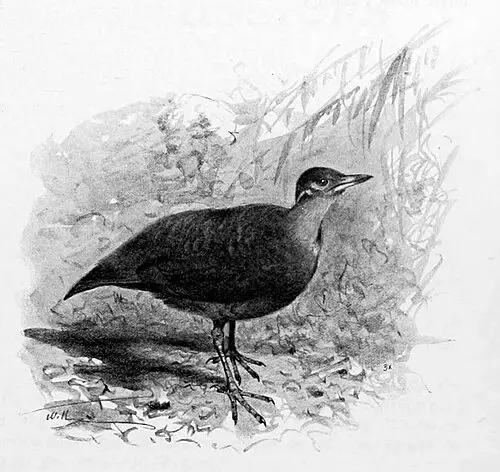
 📸 Photo
Photo: Wilhelm Kuhnert published by Julien Salmon (1844-1921) · Public domain · Wikimedia Commons Source
White-breasted Mesite
Mesitornis variegatus (White-breasted Mesite · ムナジロクイナモドキ)
💡 Everyday Comparisons for Size, Mass & Speed
- 💡 The way young birds slowly learn to forage and stay with their parents for a long time can be likened to a family where grown children take longer to become independent.
- 💡 In the Kirindy Forest of the western Menabe region, slash-and-burn agriculture and other pressures reduced forest cover by an average of 0.67% per year between 1973 and 2010, and this bird is counted among the vertebrates with an extremely narrow range living there.
Reference standards: coach bus ~12 m, mid-size car ~4.9 m, compact car ~1 t, basketball hoop 3.05 m, credit card 8.56 cm.
📖 1. Overview
The White-breasted Mesite is a medium-sized ground-dwelling bird endemic to the dry forests of western Madagascar, living in pairs or small family groups. It has been little studied and is classified as Vulnerable (VU).
🦴 2. Anatomy & Morphology
Males and females look alike and have weak flight muscles. Early anatomical studies recorded a low sternal keel, the absence of a furcula (wishbone), and 5 pairs of powder-down patches.
🔍 3. Ecology & Behavior
It is monogamous, with a pair defending the same territory year-round, and its chicks are semi-precocial. Young birds learn to forage slowly and stay with their parents for a long time before dispersing, and because parents turn aggressive toward older offspring, cooperative breeding does not occur.
🇰🇷 4. Connection to Korea
No direct record connecting this species to Korea has been found.
📚 Sources & References
- • IUCN Red List VU (2018) — https://www.iucnredlist.org/species/22692949/129882359
- • IUCN Red List category VU — latest assessment at iucnredlist.org
- • doi.org — avilist.v2026
- • iucnredlist.org — 129882359
- • wikidata.org — Q1272798
- • commons.wikimedia.org — File:Mesitornis variegatus.jpg
- • link.springer.com — s12686-012-9850-z
- • link.springer.com — s00265-013-1624-4
- • link.springer.com — s00265-015-1943-8
- • link.springer.com — s10113-013-0475-x
- • zenodo.org — content
- • zenodo.org — content
- • Silhouette: PhyloPic — Ferran Sayol · CC0 1.0 (Congeneric silhouette — Mesitornis unicolor)
Recorded dimensions are widely cited representative estimates from public literature and may vary by study or specimen.