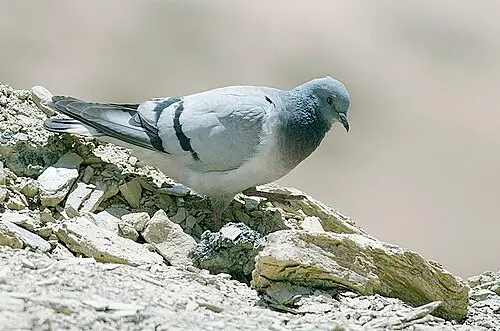
 📸 Photo
Photo: As kannan · CC BY-SA 4.0 · Wikimedia Commons Source
Hill Pigeon
Columba rupestris (Hill Pigeon · コウライバト)
🇰🇷 Class II endangered wildlife (Korea)
💡 Everyday Comparisons for Size, Mass & Speed
- 💡 The Encyclopedia of Korean Culture notes a case of a flock settling on the piers of the Bridge of Freedom over the Hantangang River.
- 💡 At Hwaeomsa Temple in Gurye, it uses spaces and eaves under buildings such as Gakhwangjeon and Daeungjeon halls as roosts (National Institute of Ecology).
- 💡 Its body length of 33–35 cm is less than one handspan longer than the long side of an A4 sheet of paper (29.7 cm) (Comparison).
Reference standards: coach bus ~12 m, mid-size car ~4.9 m, compact car ~1 t, basketball hoop 3.05 m, credit card 8.56 cm.
📖 1. Overview
The hill pigeon (listed as Nang-bidulgi, Korean name, on the National List of Species of Korea) is a grey pigeon 33–35 cm long distributed across Central Asia, Siberia, China, Mongolia, and Korea. It is known as an ancestor of the rock dove.
🦴 2. Anatomy & Morphology
It is greyish overall with a glossy green neck, a shimmering purplish breast, and a white rump. There is a broad white band across the middle of the tail, and the irises and legs are red.
🔍 3. Ecology & Behavior
It lives in flocks feeding on grass seeds in farmlands and grasslands, breeding mainly from March to October (months 3–10) and sometimes even in winter. It nests on coastal cliffs, rock crevices, bridge piers, and under temple eaves.
🇰🇷 4. Connection to Korea
It is a Class II endangered wildlife (Korea) species (designated in 2017), and its Korean species name was changed from Yang-bidulgi (Korean name) to Nang-bidulgi (Korean name) in 2021. In Korea, it is confirmed at three sites: Gurye, Goheung, and Yeoncheon.
📚 Sources & References
- • IUCN Red List LC (2024) — https://www.iucnredlist.org/species/22690074/263608982
- • 멸종위기 야생생물 Ⅱ급 — 국가생물종목록(국립생물자원관) ktsn 120000001821 — https://species.nibr.go.kr/home/mainHome.do?cont_link=009&subMenu=009002&contCd=009002&ktsn=120000001821
- • IUCN Red List category LC — latest assessment at iucnredlist.org
- • Korean protection status: Class II endangered wildlife (Korea)
- • doi.org — avilist.v2026
- • iucnredlist.org — 263608982
- • 국가생물종목록(국립생물자원관) ktsn 120000001821 — https://species.nibr.go.kr/home/mainHome.do?cont_link=009&subMenu=009002&contCd=009002&ktsn=120000001821
- • wikidata.org — Q754662
- • commons.wikimedia.org — File:Hill Pigeon, near Dras, Jammu and Kashmir, India.jpg
- • nibr.go.kr — ecatalogt.jsp
- • nie.re.kr — ecatalogt.jsp
- • encykorea.aks.ac.kr — E0025113
- • Silhouette: PhyloPic — Ferran Sayol · CC0 1.0 (Congeneric silhouette — Columba)
Recorded dimensions are widely cited representative estimates from public literature and may vary by study or specimen.