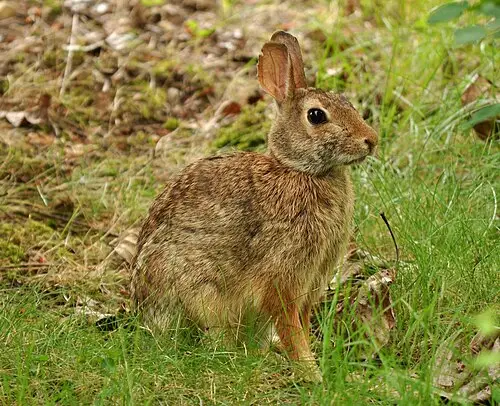
 📸 Photo
Photo: The High Fin Sperm Whale · CC BY-SA 3.0 · Wikimedia Commons Source
Eastern Cottontail
Sylvilagus floridanus (Eastern Cottontail · トウブワタオウサギ)
💡 Everyday Comparisons for Size, Mass & Speed
- 💡 Abundant and edible, it is a prominent game animal hunted for sport, meat, and fur.
- 💡 Its favorite summer foods include clover, wild strawberries, and garden vegetables.
- 💡 Its maximum weight of 1.53 kg is similar to a 1.5 L bottle of water (Comparison).
Reference standards: coach bus ~12 m, mid-size car ~4.9 m, compact car ~1 t, basketball hoop 3.05 m, credit card 8.56 cm.
Site-computed relative index from recorded values; not a formal scientific metric.
📖 1. Overview
The Eastern Cottontail is a common North American rabbit that lives along the edges between woods and open fields.
🦴 2. Anatomy & Morphology
Its back is covered in gray- and black-tipped guard hairs, with a reddish-brown patch on the nape and a white belly. When running it flashes the white underside of its short tail, and it molts twice a year in spring and autumn.
🔍 3. Ecology & Behavior
Solitary and active at dusk and night, it remains active throughout winter. Grasses make up about 50% of its summer diet, while in winter it eats twigs, bark, and buds, and it reingests cecal pellets to absorb nutrients.
🇰🇷 4. Connection to Korea
No direct record connecting this species to Korea has been found.
📚 Sources & References
- • IUCN Red List LC (2019) — https://www.iucnredlist.org/species/41299/45191626
- • IUCN Red List category LC — latest assessment at iucnredlist.org
- • mammaldiversity.org — 1001131
- • iucnredlist.org — 45191626
- • wikidata.org — Q774716
- • commons.wikimedia.org — File:Eastern Cottontail (Sylvilagus floridanus).JPG
- • animaldiversity.org — Sylvilagus floridanus
- • Silhouette: PhyloPic — author not recorded · CC0 1.0 (Congeneric silhouette — Sylvilagus audubonii)
Recorded dimensions are widely cited representative estimates from public literature and may vary by study or specimen.