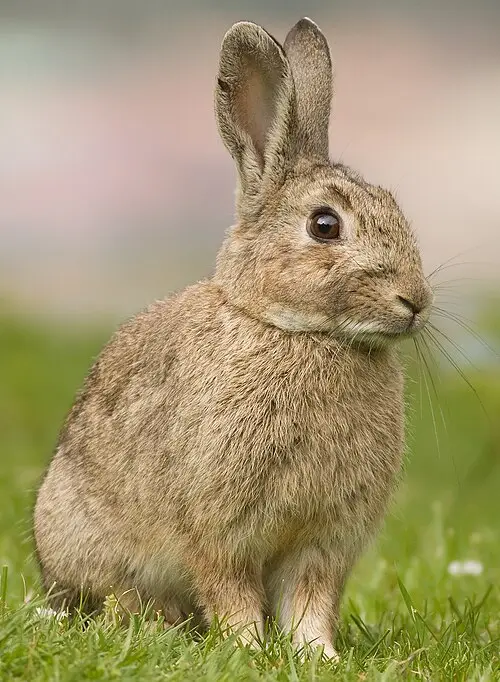
 📸 Photo
Photo: JJ Harrison · CC BY-SA 3.0 · Wikimedia Commons Source
European Rabbit
Oryctolagus cuniculus (European Rabbit · アナウサギ)
💡 Everyday Comparisons for Size, Mass & Speed
- 💡 All roughly 80 breeds of domestic rabbit descend from this species, and it is also a popular pet.
- 💡 It is raised for meat, pelts, and wool, and about 500,000 individuals are used each year in medical research and product safety testing.
- 💡 A maximum weight of 2.5 kg equals the weight of a 2.5 kg bag of rice (Comparison).
Reference standards: coach bus ~12 m, mid-size car ~4.9 m, compact car ~1 t, basketball hoop 3.05 m, credit card 8.56 cm.
Site-computed relative index from recorded values; not a formal scientific metric.
📖 1. Overview
The European Rabbit is the ancestor of all domestic rabbits and lives in social groups in underground burrows.
🦴 2. Anatomy & Morphology
Measuring 38–50 cm in body length, it has grayish fur mixed with black and brown and a white underside to the tail. Its ears are smaller and its legs shorter than those of hares.
🔍 3. Ecology & Behavior
It eats grasses, leaves, buds, bark, and roots, and reingests cecotropes to extract extra nutrients. Colonies of 6–10 adults live in burrow networks (warrens), and after a gestation of about 30 days females give birth to 5–6 young per litter.
🇰🇷 4. Connection to Korea
No direct record connecting this species to Korea has been found.
📚 Sources & References
- • IUCN Red List EN (2019) — https://www.iucnredlist.org/species/41291/170619657
- • IUCN Red List category EN — latest assessment at iucnredlist.org
- • mammaldiversity.org — 1001113
- • iucnredlist.org — 170619657
- • wikidata.org — Q25851
- • commons.wikimedia.org — File:Oryctolagus cuniculus Tasmania 2 (cropped).jpg
- • animaldiversity.org — Oryctolagus cuniculus
- • Silhouette: PhyloPic — Steven Traver · CC0 1.0
Recorded dimensions are widely cited representative estimates from public literature and may vary by study or specimen.