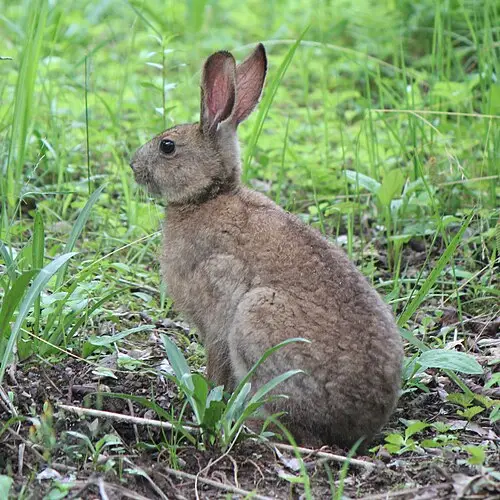
 📸 Photo
Photo: Alpsdake · CC BY-SA 3.0 · Wikimedia Commons Source
Japanese Hare
Lepus brachyurus (Japanese Hare · ニホンノウサギ)
💡 Everyday Comparisons for Size, Mass & Speed
- 💡 In Japan, it is a resource for meat and fur.
- 💡 It sometimes damages newly planted cedar plantations by feeding on young trees.
- 💡 Its average length of 50.5 cm is about 1.7 times the long side of an A4 sheet of paper (29.7 cm) (Comparison).
Reference standards: coach bus ~12 m, mid-size car ~4.9 m, compact car ~1 t, basketball hoop 3.05 m, credit card 8.56 cm.
Site-computed relative index from recorded values; not a formal scientific metric.
📖 1. Overview
The Japanese Hare is a medium-sized hare living along forest edges and in rural areas across Japan, mainly active alone at night.
🦴 2. Anatomy & Morphology
Its coat ranges from dark brown to reddish-brown mixed with white patches. Two subspecies (angustidens and lyoni) turn white in winter, and behind the upper incisors sits a small second pair of peg incisors.
🔍 3. Ecology & Behavior
Instead of digging burrows, it hides in scrub during the day and travels about 1,000 m through the forest in a single night. It eats grasses in summer and buds of young trees and young bamboo in snowy northern winters, producing 4–5 litters of 1–4 young from January to August.
🇰🇷 4. Connection to Korea
No direct record connecting this species to Korea has been found.
📚 Sources & References
- • IUCN Red List LC (2019) — https://www.iucnredlist.org/species/41275/45186064
- • IUCN Red List category LC — latest assessment at iucnredlist.org
- • mammaldiversity.org — 1001082
- • iucnredlist.org — 45186064
- • wikidata.org — Q1355766
- • commons.wikimedia.org — File:Lepus brachyurus.JPG
- • animaldiversity.org — Lepus brachyurus
- • Silhouette: PhyloPic — Margot Michaud · CC0 1.0 (Congeneric silhouette — Lepus saxatilis)
Recorded dimensions are widely cited representative estimates from public literature and may vary by study or specimen.