 📸 Photo
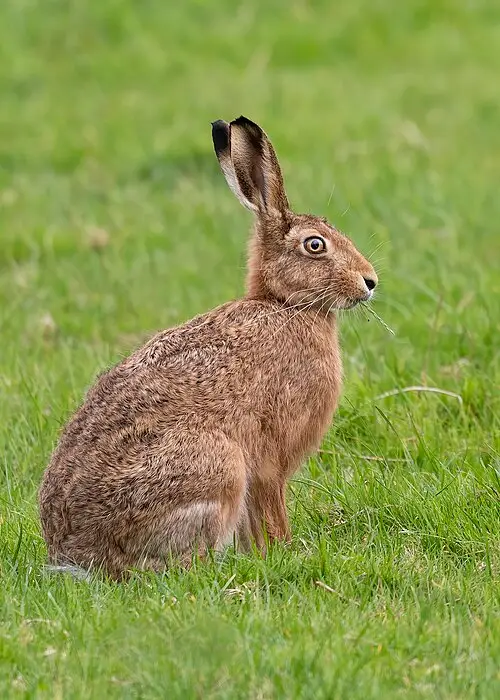
Photo: caroline legg · CC BY 2.0 · Wikimedia Commons Source
European Hare
Lepus europaeus (European Hare · ヤブノウサギ)
💡 Everyday Comparisons for Size, Mass & Speed
- 💡 Its top straight-line speed of about 60 km/h is around the speed limit of an urban arterial road (50–60 km/h) (Comparison).
- 💡 In North America it is a popular game animal, and its meat is said to be white and tasty.
- 💡 Two or three adults eat as much grass as a single sheep.
Reference standards: coach bus ~12 m, mid-size car ~4.9 m, compact car ~1 t, basketball hoop 3.05 m, credit card 8.56 cm.
Site-computed relative index from recorded values; not a formal scientific metric.
📖 1. Overview
The European Hare is a large hare living in open fields, staying among grass clumps without digging burrows.
🦴 2. Anatomy & Morphology
Its long ears have black tips, its coat is yellowish-brown to grayish-brown, and its tail is black on top and white underneath. In winter its coat does not turn white, becoming only slightly grayer.
🔍 3. Ecology & Behavior
Mostly solitary, it forages at dusk and night and crouches during the day in a shallow depression (form) in the grass. After a gestation of 30–42 days it gives birth to an average of 3–5 young per litter, eating grasses and crops in summer and twigs, buds, and bark in winter.
🇰🇷 4. Connection to Korea
No direct record connecting this species to Korea has been found.
📚 Sources & References
- • IUCN Red List LC (2019) — https://www.iucnredlist.org/species/41280/45187424
- • IUCN Red List category LC — latest assessment at iucnredlist.org
- • mammaldiversity.org — 1001090
- • iucnredlist.org — 45187424
- • wikidata.org — Q26838
- • commons.wikimedia.org — File:European Brown Hare (50341079472).jpg
- • animaldiversity.org — Lepus europaeus
- • Silhouette: PhyloPic — Ferran Sayol · CC0 1.0
Recorded dimensions are widely cited representative estimates from public literature and may vary by study or specimen.