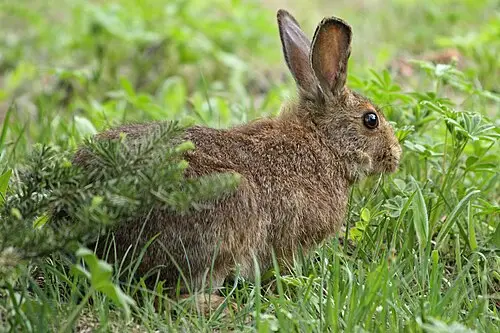
 📸 Photo
Photo: Lepus_americanus_5459.JPG : Walter Siegmund (talk) derivative work: Wsiegmund · CC BY-SA 3.0 · Wikimedia Commons Source
Snowshoe Hare
Lepus americanus (Snowshoe Hare · カンジキウサギ)
💡 Everyday Comparisons for Size, Mass & Speed
- 💡 It is widely used as a source of wild meat and is also prey for many predators with valuable fur.
- 💡 Its maximum weight of 1.55 kg is similar to a 1.5 L bottle of water (about 1.5 kg) (Comparison).
- 💡 Its winter coat turns white, making it less noticeable in snow-covered forests.
Reference standards: coach bus ~12 m, mid-size car ~4.9 m, compact car ~1 t, basketball hoop 3.05 m, credit card 8.56 cm.
Site-computed relative index from recorded values; not a formal scientific metric.
📖 1. Overview
The Snowshoe Hare is a hare living in northern North American forests and thickets whose coat changes from brown in summer to almost white in winter.
🦴 2. Anatomy & Morphology
Its long, broad hind feet are shaped like snowshoes and measure 117–147 mm in length. Its summer coat is reddish-brown or grayish-brown, while in winter it turns almost entirely white except for black eyelids and ear tips.
🔍 3. Ecology & Behavior
Solitary though sometimes living at high densities, it travels along packed-down trails at dusk, night, and dawn. It eats grasses and shoots in summer and buds, twigs, and bark in winter, giving birth to an average of 2–4 young (up to 8) after a 36-day gestation.
🇰🇷 4. Connection to Korea
No direct record connecting this species to Korea has been found.
📚 Sources & References
- • IUCN Red List LC (2019) — https://www.iucnredlist.org/species/41273/45185466
- • IUCN Red List category LC — latest assessment at iucnredlist.org
- • mammaldiversity.org — 1001080
- • iucnredlist.org — 45185466
- • wikidata.org — Q81063
- • commons.wikimedia.org — File:Lepus americanus 5459 cropped.jpg
- • animaldiversity.org — Lepus americanus
- • Silhouette: PhyloPic — Maha Ghazal · Public Domain Mark 1.0
Recorded dimensions are widely cited representative estimates from public literature and may vary by study or specimen.